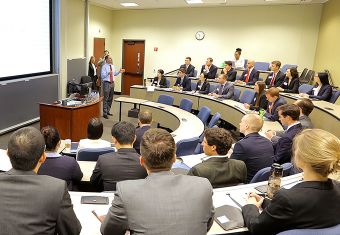
The MAC program is taught on a module (Mod) schedule. The MAC program’s academic year includes two modules in the fall semester and two modules in the spring semester. A module is the equivalent of half a semester or 7 weeks. A module course is usually 1.5 credit hours.
The minimum number of credit hours required to graduate is 30.5. The MAC program curriculum is divided into three parts: core courses (13.5 credit hours), tax (11.0 credit hours) or audit (8.0 credit hours), and electives (audit: 9.0 credit hours and tax: 6.0 credit hours).
- Core Curriculum
- Tax Requirements
- Audit Requirements
- Elective Courses
Core Curriculum
The core courses are required of all students in the program. Those courses are as follows:
MAC 711 (3.0 credit hours)
Financial Reporting B examines the theoretical foundations of financial reporting, the environmental factors that affect accounting standard-setting and decision-making, and the mechanics of accounting for events and transactions that have an economic effect on the firm. Course participants will gain an understanding of the preparation of financial statements, as well as the skills necessary to interpret financial accounting information.
Prerequisites: 700 for 710, 710 for 711.
MAC 714 (1.5 credit hours)
Financial Statement Analysis is the capstone course of the Financial Accounting sequence. It provides an applied perspective on analyzing firms’ financial statements using lectures and Harvard case studies. Key topics include earnings management, profitability analysis, credit analysis, predicting financial distress, pro-forma business modeling and industry analysis.
Prerequisite: 712.
MAC 725 (1.5 credit hours)
Cost Accounting examines the application of cost accounting techniques and practices for manufacturing and service organizations. Special focus is given to the strategic context of cost system design and the application of cost accounting techniques to decision-making. The course uses cases to help students contextualize cost accounting topics and to understand the impact of cost accounting information on firm decision-making. Topics include cost accounting systems, strategic costing, activity-based costing, cost management systems, responsibility accounting and transfer pricing.
Prerequisite: 701.
MAC 730 (3.0 credit hours)
Auditing and Assurance Services offers a foundation in the external audit function and stresses the role and value of auditing in business. Students consider the effect of environmental factors and standards on auditors' judgments of client acceptance, risk assessment, planning, evidence gathering and reporting.
Prerequisite: 711.
MAC 743 (1.5 credit hours)
Deloitte Corporate Taxation analyzes tax laws with respect to corporate formation, shareholder distributions, liquidations, divestitures, mergers and acquisitions.
Prerequisite: 742.
MAC 884A & B (3.0 credit hours)
Leadership, Ethics & Professionalism I & II address ethical theories coupled with critical thinking approaches to analyzing ethical issues. These courses help students understand when they confront ethical issues and provide a mechanism for helping students think their way through to making ethical decisions. These courses provide a useful way to identify and understand the values they bring to bear in making important decisions with ethical components. In addition, students will develop critical managerial and leadership skills in the areas of communication, persuasion and influence, team leadership and decision-making. Students also will participate in a management simulation created specifically for accounting professionals and receive feedback on their performance from industry executives.
Tax Requirements
Students concentrating in tax have 11.0 credits of required tax coursework.
*Indicates tax courses that students, concentrating in audit, may take as electives.
MAC 740 (1.5 credit hours)
*Individual Income Taxation covers major tax compliance and policy issues inherent in individual taxation, including filing status, income, deductions, gains and losses, and credits.
Prerequisite: 700.
MAC 742 (1.5 credit hours)
*Tax and Business Strategy develops a conceptual framework for analyzing taxes that course participants apply to contemporary decision contexts, including investments, compensation, organizational form, regulation, financial instruments, shelters and family wealth planning.
Prerequisite: 741.
MAC 744 (1.5 credit hours)
Corporate Tax II builds on MAC 743 by providing a more in-depth study of the federal income taxation of C Corporations and their shareholders. Specifically, we will further explore the tax consequences associated with formation, operation, distributions, reorganizations and liquidations of corporations.
MAC 840 (.5 credit hours)
Tax Research considers the diverse sources of tax law. Course participants learn to access electronic databases, analyze typical client situations and communicate research results.
Prerequisite: 740.
MAC 841 (3.0 credit hours)
International Tax focuses primarily on the U.S. tax laws applicable to individuals and business investing and operating businesses abroad. Specific international tax topics include jurisdiction, source of income, allocation and apportionment of deductions, foreign tax credit planning, anti-avoidance provisions and transfer pricing. The course also will introduce students to some of the basic concepts of multistate income and sales & use taxation.
Prerequisite: 741.
MAC 842 (1.5 credit hours)
Taxation of Flow-Through Entities: Partnerships & SCorps analyzes tax laws related to partnerships, S corporations, limited liability corporations and other flow-through entities. Course participants discuss partnership formation, compensation and allocation of partnership income, transactions and changes in partnership interests, family partnerships, and S corporation and limited liability requirements.
Prerequisite: 741.
Audit Requirements
Students concentrating in audit have 8.0 credits of required audit and assurance services coursework.
**Indicates audit courses that students, concentrating in tax, may take as electives.
MAC 713 (1.5 credit hours)
**Accounting for Mergers and Acquisitions emphasizes the financial and economic aspects of mergers and acquisitions with a focus on the challenges of preparing financial statements for conglomerates with domestic and international subsidiaries.
Prerequisite: 711.
MAC 715 (1.5 credit hours)
**International Financial Reporting Standards is designed to provide an understanding of the financial reporting requirements of the International Financial Reporting Standards (IFRS). The course assumes that students already have knowledge of financial reporting requirements under U.S. GAAP. A “differences” approach is taken, where the material presented relates to areas where IFRS differs from U.S. GAAP.
MAC 811 (1.5 credit hours)
**Fraudulent Financial Reporting is designed to provide a broad overview of the nature of occupational fraud. In particular, the course focuses on asset misappropriation and fraudulent financial reporting. The course is structured as a combination of lectures and case discussions. The regulatory and legal issues surrounding these types of occupational frauds also are covered.
MAC 830 (1.5 credit hours)
Advanced Auditing provides an in-depth examination of technical auditing topics introduced in MAC 730 Auditing and Assurance Services. Topics include strategic risk analysis, corporate governance, internal control assessments, audit sampling and modified audit reports.
Prerequisite: 730.
MAC 832 (0.5 credit hours)
Financial Research provides course participants with applied knowledge in the use of electronic databases to access the accounting and auditing technical literature, company financial statements and industry data for the purpose of analyzing conceptually challenging accounting issues. The course focuses on the development of these skills through the use of case studies.
Prerequisite: 711.
MAC 889 (1.5 credit hours)
**IT for Accountants introduces course participants to the technology and internal controls used in contemporary information systems to capture, process and communicate financial and managerial accounting data.
Elective Courses
Both tax and audit students may take these courses. Students concentrating in audit take 9.0 credits of any combination of electives, including certain tax courses. Students concentrating in tax take 6.0 credits of electives, including certain audit courses.
MAC 703 (1.5 credit hours)
Contracts & Business Law will present an overview of the American legal system, the role of the courts, and regulation, litigation and constitutional issues. The primary purpose of this course is to introduce the student to the legal environment of business. NOTE: This course is required for non-BSBAs.
MAC 707 (1.5 credit hours)
Introduction to Technology: Advanced Spreadsheet Modeling focuses on using advanced features of Microsoft Excel to create efficient spreadsheet models of common business problems. It challenges students to use critical thinking and analysis to find effective solutions to real-life situations. Course topics include an introduction to problem-solving and decision-making, statistical analysis tools, determining effective data display with charts, applying logic in decision-making, locating and managing data with reference functions, evaluating the financial impact of loans and investments, organizing data for complex analysis, performing what-if analyses with data tables and scenarios, enhanced decision-making with goal seek and solver, and troubleshooting and customizing workbooks with visual basic programming and other advanced tools.
MAC 856 (3.0 credit hours)
Global Immersion Elective The Global Immersion Electives (GIEs) provide students in the MAC program at UNC Kenan-Flagler with an opportunity to engage in short-term experiential learning abroad for academic credit. There are several successful GIEs to the program's credit. Previous countries visited include China, South Africa and Brazil. GIEs combine relevant and timely international business issues with nuts-and-bolts discussions of how to do business in targeted countries or regions; the electives highlight some of the most dynamic economies in the world.
MAC 857 (1.5 credit hours)
Equity Analysis and Valuation explains how and why the wealth and business decisions of auditors, consultants, CFOs, CEOs, investors, regulators and employees depend on a firm's past, present and future stock value. It will provide course participants with the theoretical and practical tools necessary to both value a firm and understand the valuation techniques used by other business professionals.
Prerequisite: 714.
MAC 861 (1.5 credit hours)
Consulting Skills and Frameworks is designed to provide students with immediately usable tools for any team problem-solving situation. The core consulting skill training will focus on the all-important “TAP” skills (teamwork, analysis and presentations) and will introduce the TEAM FOCUS framework that covers the following aspects of team problem-solving – Talk, Evaluate, Assist, Motivate, Frame, Organize, Collect, Understand and Synthesize. We will also cover a few of the most critical high-level functional frameworks used by top consulting firms today.
MAC 863 (1.5 credit hours)
Managing Workplace Diversity is designed to improve your awareness of the importance of effectively managing workplace diversity, not only as a social or moral goal, but also as a sound business practice—enlightened self-interest. Toward this end, the goals are to (1) increase your appreciation of your own cultural values; (2) heighten your sensitivity to the unique characteristics of other groups; and (3) thereby enhance your ability to manage people of diverse backgrounds.
MAC 866 (1.5 credit hours)
Intro to Derivatives and Securities Markets examines the economic fundamentals and inherent risk features of various financial instruments such as options and forward and futures contracts.
Prerequisite: 709.
MAC 867 (1.5 credit hours)
Advanced Corporate Finance focuses on the fundamental concepts of corporate finance and how to apply them to real-life situations. The course will explore multiple valuation techniques, including discounted cash flow and multiples. In addition, capital structure, financial distress and payout policy will be covered. This course is for liberal arts majors or by permission.
MAC 875 (1.5 credit hours)
Agency and Unincorporated Business Associations covers agency law, property law, bankruptcy, partnerships, limited partnerships, limited liability companies, limited liability partnerships and limited-liability limited partnerships.
Prerequisite: 703.
MAC 876 (1.5 credit hours)
Corporations and Securities Regulations covers state law governing corporations and federal regulations of securities.
Prerequisite: 703.
MAC 877 (1.5 credit hours)
Commercial Law covers secured transactions (Article IX) and negotiable instruments (Article III) under the Uniform Commercial Code. Secured transactions and negotiable instruments are critical to commerce and the world’s economic system.
Prerequisite: 703.
MAC 880 (1.5 credit hours)
Negotiation addresses basic theories of good negotiation with a heavy focus on "Principled Negotiation" as advanced by professors Roger Fisher and Bill Ury. Also, students work extensively on effective techniques for planning and conducting negotiations. Specific topics include emotions, power, dealing with difficult people, persuasion and negotiation "tricks
."