News & Stories
Building real-world real estate leaders
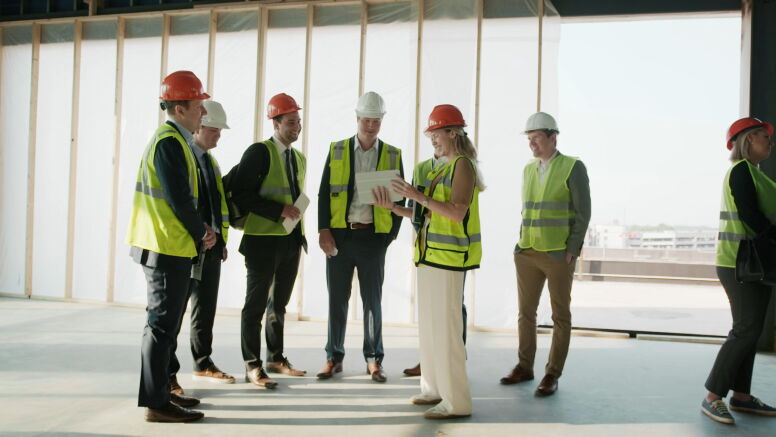
For 25 years the Wood Center for Real Estate Studies at UNC Kenan-Flagler Business School has focused on real estate, but “location, location, location” has not been its guiding mantra.
Instead, it’s been “relationships, relationships, relationships.”
The Wood Center is where real estate leaders are made through rigorous, real-world preparation, unmatched industry integration and a community-first model of lifelong connection.
“One of the key assets of the Wood Center is the high level of engagement between our students, our faculty, our alumni, our donors and the industry. We work hard to be relevant with all of these critical stakeholders which has made the Wood Center’s impact so strong,” says Jeff Tucker (MBA ’00).

Since its creation, the center has functioned as an accelerant for UNC Kenan-Flagler’s real estate program and for the careers of thousands of alumni — supporting students and faculty, nurturing an active alumni network and building robust relationships with industry partners around the world.
Common ground
The power of those relationships was brought home when Liz Smith (MBA/MCRP ’01), senior vice president development at Vivmark Residential, moved to North Carolina in 2021 from Boston to open a new office for her company, a real estate investment trust focused on multifamily developments.
“You can pick up the phone and you’re talking to either a land seller or a colleague who also works as a developer or broker and that person shares that Carolina background,” she says. “There’s a sense of common ground that you’re starting with. That’s really important in real estate because relationships drive this business.”
Smith is one of many alumni who credit UNC Kenan-Flagler’s faculty — and especially Dave Hartzell (PhD ’85), the Steven D. Bell and Leonard W. Wood Distinguished Professor of Finance — with introducing them to the field of real estate.
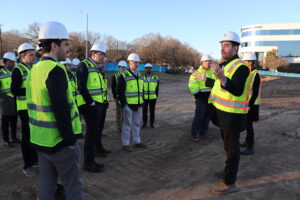
“Dave Hartzell taught a real estate finance and development class that I took the second semester of my senior year,” says Robert McCall (BSBA ’03), partner at New York-based GTIS Partners, a real estate private equity firm. “Within a matter of weeks, I realized, ‘Real estate is what I want to do.’”
“I have a significant personal debt to Hartzell, to the Business School and to Carolina because I’m still doing real estate 23 years after I graduated.”
The robust alumni network that the Wood Center has helped cultivate also serves as a rich recruiting ground for business leaders who need high performers with real estate expertise.
Tucker, who returned to UNC Kenan-Flagler in 2023 to serve as the Wood Center’s executive director, took Hartzell’s class in 1999, and went into private equity after graduation. A few years into his career, he cofounded Century Bridge Capital, a firm developing residential real estate projects in China.
In 2007, Tucker needed to hire an MBA, and his first call was to Hartzell. He didn’t really expect Hartzell to have a job candidate — his requirements were very, very specific.
“I said, ‘I need a second-year MBA who’s about to graduate, a real estate concentrator who speaks Mandarin fluently, who speaks English fluently, and wants to work for a less than one-year-old private equity startup in Beijing, China,” says Tucker.
Hartzell’s response: “I’ve got your guy.”
Supporting students
Fostering connections rooted in a common Carolina experience and a top-quality education in real estate finance and development are at the heart of the Wood Center’s mission.
UNC Kenan-Flagler formed the Center for Real Estate Development in 2001 thanks to the leadership of Leonard Wood (MBA ’72) and it was renamed the Leonard W. Wood Center for Real Estate Studies in 2013.
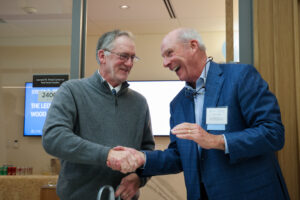
Dave Hartzell (PhD ’85) and Leonard W. Wood celebrate the ribbon cutting of the Wood Center space in Bell Hall.
Professor Mike Miles taught the first undergraduate real estate class in 1976, and later taught MBA classes and helped usher through some of the real estate program’s first PhD students, including Hartzell.
Hartzell joined the UNC Kenan-Flagler faculty in 1988 and watched Miles work his industry contacts, helping real estate students find jobs and creating a program that was starting to attract MBA students interested in real estate. In the late ‘90s, UNC Kenan-Flagler officially designated real estate as one of the first of the Full-Time MBA Program concentrations.
“From the very beginning, we designed our program to support students,” Hartzell says.
If those years of real estate-focused research, education, mentoring and career guidance for students built the foundation for the center, it was Wood’s gift in 2001 to establish the center that built the walls.
The activities and resources provided by Wood’s gift, plus support from other alumni and donors, create a unique experience for Undergraduate Business and MBA real estate students: Staff to support students, events, faculty hiring, scholarships, student treks to major U.S. cities, an annual Global Immersion Elective and more.
The Wood Center also hosts an annual real estate conference that brings together industry, students and academic researchers. The event, which now draws 900-plus people, has outgrown its initial setting at the Carolina Club and now is held at the Dean E. Smith Center.
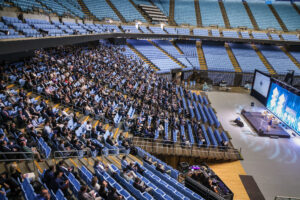
The Wood Center’s annual conference draws 900-plus people.
“We’ve created all kinds of really cool stuff as the funding model has grown,” Hartzell says.
One of the most notable innovations is the first of its kind real estate investment fund. Established in 2007, the fund raises capital and invests it in real estate. It took more than two years to get approval from the University and the UNC System, Hartzell says, because it was such an unusual idea — a for-profit real estate investment fund operated inside a business school. The fund’s managers are MBA and Undergraduate Business students who take on real fiduciary responsibilities, including pitching investors, sourcing deals, monitoring returns and reporting their results to investors.
Since its inception, the KFBS Real Estate Funds have raised $18.6 million over five funds, with a sixth planned to launch in the 2026-27 academic year. Some 188 student managers have worked on the funds since they launched.
In 2019, the center launched the Housing Affordability Initiative, a mix of research and programs aimed squarely at one of the biggest economic challenges in the country led by Professor Eric Maribojoc.
Reshaping the landscape
Real estate is being transformed by cutting-edge technology. Advanced data analytics and AI are changing how developers and investors assess sites and projects.
“We’re moving into a whole new technology world with AI and data science,” Tucker says. “Real estate is a data-rich industry, which in many ways multiplies the positive effects that AI and data science can yield. That’s changing the entire landscape of how investment and development decisions get made in real estate.”
Real estate students are learning about data science and analytics. The Wood Center recently named Drew Conway, the head of data science for private markets at Two Sigma, as its technologist in residence. Conway is one of the most respected real-estate data scientists in the U.S. and he’s advising on the curriculum and delivering a series of data science lectures to MBAs and undergrads.
The goal, Tucker says, isn’t to turn real estate students into data scientists. It’s to teach them how to think about data and use it in real estate.
“We’re teaching them how to communicate with data scientists and how to make decisions, how to ask the right questions of these data scientists,” he says.
In other words, it’s still about connecting with others.
And there, too, the Wood Center is redoubling its efforts.
Connecting with others
As part of the Wood Center’s 25th anniversary, Hartzell and Tucker have been visiting cities across the U.S. to meet with alumni and others.
The center is also launching Wood Center Connect, an exclusive online community and networking platform designed to help alumni and students find one another, strengthen professional relationships, share opportunities, and stay engaged with the Wood Center no matter where their careers take them. Available through both a web-based platform and mobile app, Wood Center Connect provides a dedicated digital home for the Wood Center community.
“Think about the power and scale of this incredible network — thousands and thousands of people who come through this program and are placed in some of the top real estate firms globally. We want to harness and focus it for the benefit of the entire community,” Tucker says.
That’s really how the center measures its return on a quarter century of investing in people.
Hartzell recalls in the ’80s and early ’90s trying to convince students to come to Carolina from outside the region to study real estate. They’d ask him who the most influential alumni of the program were. At the time, he could only offer a handful of names, people like Wood and Dick Michaux (MBA ’73).
When he gets that question now, he has a different answer.
“I can give you 20 names of people who are leaders at tremendous firms,” he says. “That happens with time and as a tribute to the kinds of students that we get. But we’ve been good at being an accelerant for a lot of people.”