News & Stories
Constructing community
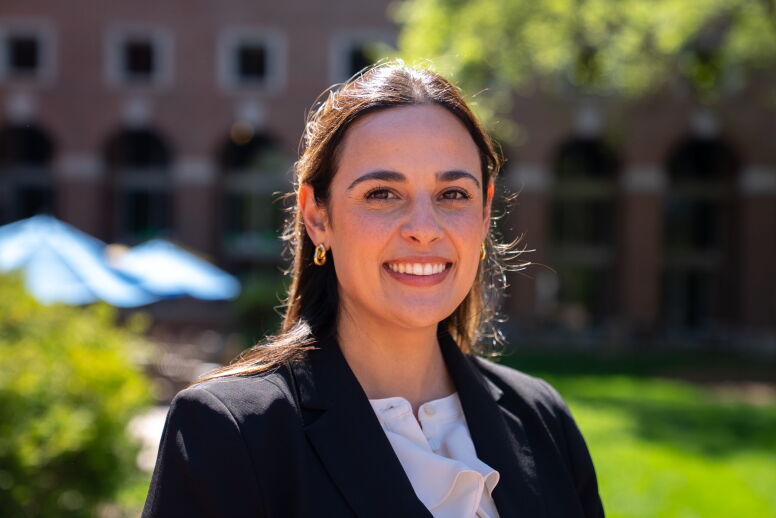
Natalie Flesher (MBA ’25) had a case of imposter syndrome before she joined the Full-Time MBA Program at UNC Kenan-Flagler Business School.
She was working as a senior financial analyst for a multifamily real estate investment trust after she earned her degree in economics and international affairs from the University of Georgia.
“I hadn’t studied finance in undergrad, and I didn’t have a real estate degree,” she says. “When I went to work in a big corporation, it felt like everyone else had been finance majors or had master’s degrees. Since I didn’t have the same credentials, I worried I might not be as capable as they were.”
When she decided to pursue an MBA, Flesher looked for an established real estate program on the East Coast with a strong network. She discovered that UNC Kenan-Flagler Business School’s Full-Time MBA Program checked all the boxes with its Real Estate Concentration and the Wood Center for Real Estate Studies.
At UNC Kenan-Flagler she learned valuable lessons that empowered her.
“I was surrounded by people I was genuinely impressed by — people I perceived as having those ‘perfect’ credentials,” says Flesher. “Yet what I saw was that they weren’t embarrassed to ask questions. They weren’t afraid to say, ‘I don’t know this; can you explain it to me?’ I saw the same humility and curiosity in alumni, too. That made me realize, ‘Wait, I am smart. Not knowing something doesn’t mean I’m not intelligent. It just means I haven’t learned it yet — and I’m fully capable of learning it.’”
What really sealed the deal was the people, she says. “There were alumni at my company who connected me with others at UNC Kenan-Flagler. Every time I spoke to someone, they were willing to connect me to someone else, and everyone was genuinely kind and helpful.”
Building confidence
Getting on campus confirmed the community was unmatched. Flesher was drawn to several groups that helped her grow personally and professionally.
Her credentials earned her several honors, including being selected as a Vetter Dean’s Fellow — a program that accelerates students’ leadership development — and as The Dearborn Family Fellow, a Forté Fellow and AFIRE Fellow.
Her biggest commitment was the Kenan-Flagler Business School Real Estate Fund, which she describes as a “hybrid of a club, an academic course and a professional experience.”
“The fund was genuinely challenging and pushed me to grow,” she adds. “It gave me opportunities to learn how to lead horizontally — where everyone is technically your peer but you still need to influence, align and manage expectations. I describe it as a sandbox for what it will one day feel like to be in a leadership position. We were all equal, but we had to manage each other’s emotions and expectations and learn how to push back on someone’s baby — the project they brought in — by saying, ‘I think this is a bad investment’ and then backing that up with facts while still being sensitive and respectful.”
The funds included Undergraduate Business Program students, which meant working with more junior teammates, which Flesher describes as “feeling very real-world.” As a member of Carolina Women in Business, Flesher formally mentored and supported undergrads by helping them prepare for job interviews. Also, as a teaching assistant in her second year, Flesher worked with undergraduates studying real estate.
Her experience with the fund is still helping her career. She is a development associate for a UNC Kenan-Flagler alumnus at Trammell Crow Residential in Atlanta.
“Today, my work involves courting equity partners,” she says. “Because of the fund, I’ve been on the other side of that table. I know how investors pick apart a deal, where they tend to see risk, and what they look for. That helps me think proactively: ‘What questions will they ask? What concerns will they have? How can we address those up front?’”
Immersive learning
UNC Kenan-Flagler also complimented Flesher’s interest in international affairs. She participated in a Global Immersion Elective and pursued global studies through other programs, too. She studied in Portugal, Morocco and South Africa.
“The Portugal experience was especially interesting because I’d already been there several times and was in the middle of planning my wedding there, but I’d never seen how business actually works,” says Flesher. “Being able to look at the country from a business and economic perspective — understanding how companies operate, what’s similar to the U.S., what’s different — was eye opening. On top of that I got to know my professor, Sylvia Gross, very well. She’s incredible, and I’m so glad I had that chance to learn from her and pick her brain in that setting.”
Case competitions also are among her highlight reels.
“Those were intense — sometimes a crazy two weekends of your life — but they were also really valuable,” she says. “Case competitions are a chance to practice leadership under high stress, when everyone has different opinions and you need to quickly coalesce around one idea and move forward. You learn that not every hill is worth dying on.”
Constructing community
The real estate curriculum helped Flesher transition from finance to development.
“The coursework matters,” she says. “Professor James Spaeth’s development course gave me very hands-on development experience: how to think through projects, how to structure them, how to anticipate challenges. I took a legal class that I think about all the time now, especially when I’m reviewing legal documents. Honestly, I wish I could have taken three more of those. I had originally thought real estate would mean sitting behind an Excel spreadsheet, but the reality is that legal documents and deal structures are a huge part of the work.”
In all her classes and clubs, Flesher developed her network.
“One of the most important lessons of my time at UNC Kenan-Flagler is the value of relationship management and ongoing network building,” says Flesher. “I used to feel that reaching out to more senior people, especially those I admired, was an inconvenience to them. I worried that I’d be a burden if I pestered them too much. What I learned is that building your network is not a one-time event: It’s a relationship you must continually work on. It’s an expectation in our industry and in leadership roles more broadly.”
Real estate is both creative and deeply human, says Flesher. “You’re creating spaces where people live, raise families and build their lives.”
In high school, she was deeply involved with a refugee resettlement agency in Atlanta. “We worked on things like building a green community center, a completely green building. I saw how proud people were of their homes, their ability to buy a home, their apartments and their community garden. Those were all ways people established roots and felt a sense of ownership and pride in where they lived.”
Now she has the opportunity to recreate that on a larger scale.
“I can help create communities that people are proud to live in, places that they feel reflect them. That human connection is what motivates me.”