News & Stories
The secret to a better chatbot
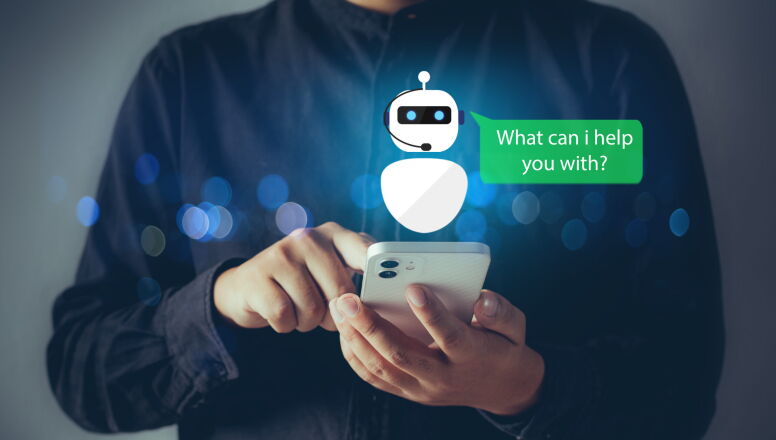
There’s something uniquely frustrating about needing to contact customer service: the nested menus that take forever to get through, robo-agents that send you in circles, and the growing desperation to speak to a human agent.
Research by Yuqian Xu, an operations professor at UNC Kenan-Flagler Business School, is furthering our understanding of what a capable AI customer-service agent looks like and how companies can improve experiences for consumers.
By now, we’re used to voice-based chatbots in our personal lives such as Google Assistant, Amazon’s Alexa, Apple’s Siri and Microsoft’s Cortana. But when businesses implement similar bots as customer-service agents, they face a number of hurdles.
Voice-based chatbots are complex compared to their earlier, text-based cousins. Oral communication is comprised of so many different variables that companies and researchers need to account for, such as tone of voice, accent and speech cadence.
Also at play are regulations like California’s Bot Disclosure Law, which require businesses to disclose when customers are interacting with AI. Laws like this aim to enhance transparency, but the disclosure could lead people to disengage when they realize they’re talking to a machine.
How can companies reap the cost-cutting benefits of AI without alienating customers or diminishing trust and competence is a question that has been at the core of Xu’s research.
In new research, she identified a way for AI customer-service agents to better meet user expectations: proactively predict customers’ needs. She shares her findings in “Voice Chatbot Design: Leveraging the Preemptive Prediction Algorithm.”
Predictions improve the customer experience
Xu and former PhD student Shuai Hao worked with a leading e-commerce company that already used chatbots to handle customer inquiries about their orders. For this study, Xu modified the AI to include a feature that proactively identified the likely package each customer was inquiring about.
Ordinarily the AI customer-service agent would give a standardized greeting before asking for the relevant tracking number. The chatbot would then follow a set number of steps to resolve the call or offer to transfer the customer to a human agent.
The modified AI, however, began each call with something like, “Are you calling about package ABC?” It made predictions using a machine-learning algorithm that analyzed key logistics-related data from the individual’s history in the company’s package tracking system. The chatbot then proactively predicted customers’ needs at the beginning of the human-AI conversation.
When the AI correctly predicted which package a customer was calling about, the results were impressive. Customer satisfaction with the interaction went up by 6.4%, call times shrank by 7.7%, and fewer calls needed to be transferred to human agents.
Xu’s research also showed that if the AI agent failed to make a proper match, the customer experience suffered, although the negative impact was considerably smaller than the positive gains achieved when the AI agent predicted correctly.
Everything else about this AI agent was identical to how it was before the experiment. The AI’s problem-solving logic was untouched, and it used the same large-language model to address customer questions. The only thing that changed was the inclusion of predictions at the beginning of the call.
Xu’s research demonstrates that establishing trust between humans and AI early in their interaction significantly increases the likelihood that customers will allow the AI to address their issues, rather than requesting a transfer to a human agent before the main conversation even begins.
Building trust in technology
Research has found that many people instinctively feel an aversion to new, advanced technology like AI that seems to mimic human qualities. They are put off by its human-like intelligence and autonomy paired with a lack of emotion and dislike the opacity behind AI’s “thinking.” That aversion can translate to a lack of faith in AI-driven products.
Xu’s research found that improving chatbot intelligence with prediction algorithms can change the calculus and help earn customers’ trust. Correct predictions signal to the user that the AI agent is competent and they can rely on it to address their concerns. This makes customers more likely to continue working with the chatbot, rather than skipping to a human agent at the first possible opportunity.
As companies increasingly implement AI technology in customer-facing roles, building trust will continue to be a critical goal. Trustworthiness helps customers have satisfactory experiences interacting with AI agents and a positive image of the companies using them.
Xu will be investigating how to enhance the trustworthiness of AI chatbots moving forward. For example, how does tone of voice affect how a customer feels about an AI agent? Do different word choices and phrasings make a difference? Should chatbots try to offer multiple predictions in a conversation? What happens if customers go way off script?
As voice-based AI chatbots become an increasing player in customer service, research like Xu’s becomes all the more important — to find out what truly works for the good of firms and consumers alike.