News & Stories
Making a sustainable impact
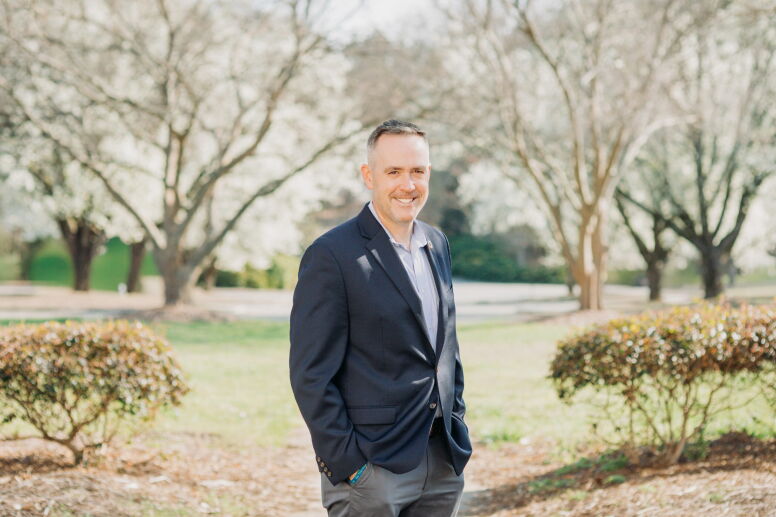
Ray Daniels (MBA ’15) runs ultramarathons, covering 50 kilometers (or more) over hours of steady, punishing effort.
Progress can be slow and uneven, like the reality of his leadership role: sustainability market development manager at BASF Agricultural Solutions in the Research Triangle area.
Daniels works on opportunities that take years to realize — making sustainable agriculture commercially viable for farmers, fuel producers and policymakers.
“I’ve studied agriculture, marketing and worked in a variety of different roles,” says Daniels. “Throughout that time, I’ve been fortunate to witness the impact our work has on the world beyond just dollars, cents and profitability. What we do impacts people, communities and the environment.”
That shift began during his studies in the Evening Executive MBA Program at UNC Kenan-Flagler Business School. He balanced a full-time role at a leading agriculture and life sciences firm in the Research Triangle Park area with evening classes in Chapel Hill.
While Daniels chose UNC Kenan-Flagler for its academic strength and reputation, what stood out most was the exposure to new ideas: “It was the access to greater minds. People who were really thinking ahead.”
“Interacting with some of the brightest minds in business, finance, marketing and strategy elevated my thinking and led me to view my work more holistically,” he says. “The faculty are leaders and trailblazers in their respective fields. Learning from them in the classroom and staying connected with them helps me look at my job, my work and my influence in a different way, always searching for ways to deepen my impact.”
Daniels graduated with a broader sense of purpose. “It was not just taking this great experience and putting it to work to make money,” he says. “It was about solving bigger challenges in the world.”
Two experiences marked that shift. The first was the STAR program, an experiential course in which student teams collaborate to solve real business challenges for corporate partners.
“Our teams were a mix of Executive MBA, Full-Time MBA and Undergraduate Business students,” says Daniels. “The dynamic was a great way to learn to lead as well as to be led. Each member brought a different skillset and perspective to the work.”
STAR taught him to frame problems in a unique way that led to breakthrough outcomes, he says. “I had no intention to pursue consulting, but the framework became foundational to how I still solve problems today.”
The second experience was a global leadership course that examined how businesses balance profit with social and environmental impact in different markets. Discussions around sustainability and bottom-of-the pyramid economics pushed Daniels to think beyond traditional business metrics and set him on a path into sustainability.
True sustainability
Daniels spent more than a decade working in pest management and public health markets in sales, marketing, leadership and strategy roles. While responsible for North America, Daniels worked with global colleagues, contributing to the broader global strategy.
“Working with people from other cultures and backgrounds taught me the importance of diversity; each person and culture has a unique context and contribution to the bigger picture. The diversity of thought aided the success of our business as well as my own personal growth” he says.
In 2022, he shifted his career focus from marketing to sustainability and joined BASF Agricultural Solutions, where he works with farmers and policymakers to make projects such as biofuels and carbon markets realities. Much of his work focuses on canola, a key Canadian crop used to produce biofuels, which creates a newer market and potential financial stream for farmers.
“At BASF, we say farming is the biggest job on earth, which is something I am proud to support,” says Daniels. However, the opportunity to open new markets for farmers comes with challenges, including making the economics work, and the problem, he says, is that sustainability often struggles when it is framed too narrowly.
“Even the word ‘sustainability’ can hold different meaning and often be misunderstood. Framing matters as much as the goal,” he says.
“If the conversation focuses only on climate change, some audiences might shut down before they hear the full message,” Daniels says. “But when we connect environmental solutions to jobs, opportunity and the long-term strength of rural communities, while also advancing conservation outcomes, it resonates with a much broader group of people.”
He sees true sustainability as pricing in the real costs. “Sustainability is not just reducing emissions. It’s doing that in a way that’s economically viable and brings people along.”
Early efforts focused narrowly on emissions, often creating unintended economic consequences and fueling skepticism, he says. “That criticism is now widespread, as scrutiny of carbon-focused approaches and greenwashing has grown.”
Much of the issue, he says, is meeting people where they are and getting them to move together — a lesson he learned through his work with the UNC Kenan-Flagler alumni community.
The alumni connection
After graduating, Daniels stayed closely involved with UNC Kenan-Flagler and went on to lead the Atlanta Alumni Chapter from 2021-2023.
“If you want to learn leadership volunteer,” he says. “You learn how to listen, motivate and encourage people.”
Those were challenging times, leading through COVID, finding ways to keep alumni connected and engaged, and eventually meeting in person, he said. “I vividly remember our first in-person meeting in 2021 with Professor Christian Lundblad as our guest speaker. I had no idea how many people would attend. We were blown away when over 90% of registered guests showed up, with many more who had simply heard about the event and wanted to reunite with fellow alumni.”
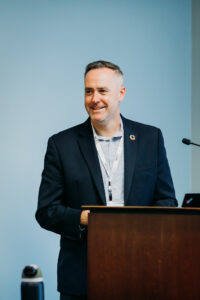
Daniels serving as a moderator at the 2026 Cleantech Summit.
The Carolina community is incredible, he says. “Our alumni make a point of staying connected and helping each other. During my time at UNC Kenan-Flagler as a student and since graduation, alumni have always been available to talk and share ideas. Whether we recount old days or discuss new ideas, there are genuine connections that create the groundwork for continued growth.”
Daniels has mentored prospective students and supports initiatives such as the LIFT Challenge and the Cleantech Summit, an annual sustainability and energy event co-hosted by the Ackerman Center for Excellence in Sustainability (ACES) at UNC Kenan-Flagler and the UNC Institute for the Environment.
“There are many opportunities to serve, and I hope to bring my experience to benefit others in meaningful ways,” he says. “I am excited to contribute to the fantastic work that the ACES team is undertaking. I want to find ways to do more to support students seeking careers in sustainability, and for those not seeking roles in sustainability, help them consider how to incorporate sustainable business principles into their work.”
When he chose UNC Kenan-Flagler, he wanted to be challenged and learn ways to be a better leader.
“When I left the program, I was a person intent on solving the biggest challenges of our time and I had the tools necessary to bring my ideas to life,” Daniels says. “UNC Kenan-Flagler continues to shape how I lead and drive results in my work.