News & Stories
Running the store
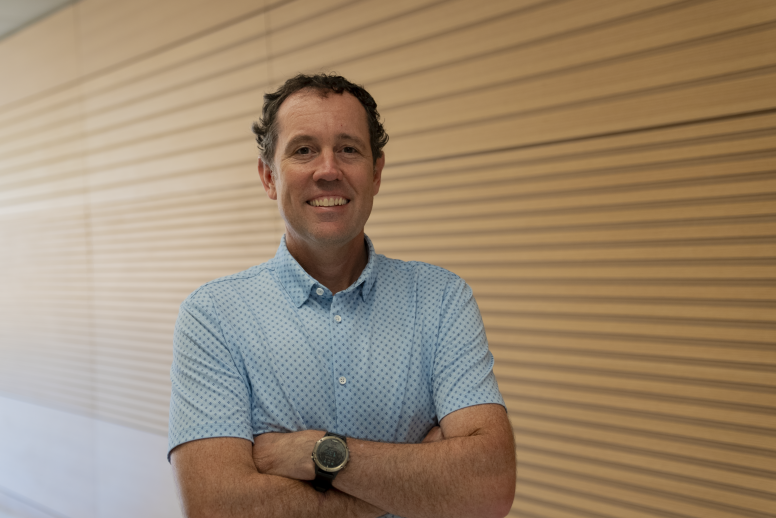
Joey Pointer (BSBA ’00, MAC ’01) learned about ringing the money bell when he first went to work at Fleet Feet’s corporate headquarters in Carrboro.
A handheld bell had a simple purpose: When the company had taken in enough cash that week to make payroll, someone got to ring the money bell — literally.
Fleet Feet’s system-wide revenue was $26 million in 2000. By the time Pointer joined the corporate franchisor in 2004, the company had just six employees and a small network of franchise stores.
Over two decades later, Pointer — now the company’s president and CEO — doesn’t need to ring the bell anymore, but he keeps it on his desk as a reminder how far both he and the company have come, both in cash flow and business maturity.
As Fleet Feet celebrates its 50th anniversary in 2026, Pointer now leads a much larger running retail platform. Fleet Feet and Marathon Sports together include more than 300 stores, 130 corporate employees and nearly $600 million in system-wide annual revenue.

Fleet Feet celebrates 50 years of “proving that retail can still be deeply human when it is rooted in service, relationships and place.”
A ticket out
Pointer’s path to the C-suite started in rural North Carolina. He grew up on a tobacco farm in a community so small that, he says, “Our baseball team only had eight players.”
Carolina was his chance for a different life. “It was my ticket to leave farming and go into something else,” he says, and he credits his UNC Kenan-Flagler Business School education with providing the foundation to change.
When Pointer arrived in Chapel Hill as a first-year student, he applied and got into the Undergraduate Business Program. And he loved it.
“Something about business and UNC Kenan-Flagler just clicked,” he says.
He stayed an extra year to earn his Master in Accounting degree. After graduation he joined Ernst & Young’s tax consulting practice in Raleigh and worked with a wide range of clients — insurance, technology, biotech and more.

Paid in running gear
He had just married Ivy, a UNC medical student, so there wasn’t a lot of extra income flowing into the young couple’s household. A serious runner, she took a part-time job at a Fleet Feet store, working a few shifts and then cashing her paychecks at the register to buy running gear.
Meanwhile at Ernst & Young, Pointer was working on R&D tax credits, interviewing the scientists and engineers making research and development decisions.
“It was so fascinating to be on the floor to see where the action happened,” he says. “That was part of my spark of realizing I didn’t always want to stay in public accounting.”
As he learned about Fleet Feet from his wife, he wondered if the company might be an avenue for applying his accounting knowledge to something different: “How amazing would it be to take my personal passion for leading a healthy and active lifestyle and blend that into the profession?”
The Fleet Feet parent company was tiny then: half a dozen employees. One was a nursing student in California who handled the corporate books part time.
Pointer interviewed for nearly a year before they hired him as financial manager. After working at Ernst & Young where there were systems for everything, he found there were questions and problems nobody had answers for at Fleet Feet. His new colleagues assumed that because he was a CPA, he would also know about insurance, banking, real estate and more.
He didn’t, but he knew he could learn.
Learning the business
Once he got the accounting running right, there wasn’t a full-time job’s worth of work for him to do. So, he started visiting Fleet Feet franchisees, reviewing their numbers.
“I went to visit a store and the owner gave me his cash log. He’s like, ‘I’ve got $700,000.’ And I’m looking at his balance sheet that his accountant had done from the end of the year, and it’s $150,000,” Pointer says. “They weren’t even in the same ballpark.”
So, he built an accounting service inside Fleet Feet — CFO in a Box — and offered it to franchisees. Eventually it grew into a dozen dedicated employees handling accounting for more than 100 locations.
After fewer than two years, he was promoted to director of operations, and by 2012 he had become chief financial officer.
The company grew just as fast, and Pointer spent a lot of time with store owners, finding and sharing good ideas, helping them all grow. In 2017 he landed in the CEO chair.
“The hard part of leading”
Though the progression looks natural, it didn’t feel that way. He wondered if taking on the CEO role was a wrong step.
“I probably regretted that decision for a year or two,” he says. “I just didn’t appreciate how hard that was. I probably had a lot of insecurity.”

Pointer at North Cascades National Park
Slowly, he got more comfortable with being the top decision maker. Now he’s learned to let other people make decisions, even when he disagrees.
When some members of his leadership team proposed a corporate sponsorship of FloTrack, a digital media company that covers running events, to support coverage of European track and field, he thought it was a bad idea. He approved it anyway.
“You have my blessing,” he told them.
Now Pointer says his team was right and his instinct was wrong. The FloTrack partnership opened doors for Fleet Feet and created new opportunities.
Pointer says his UNC Kenan-Flagler education — the broad base of business knowledge, the focus on working in teams and even public speaking — has been invaluable.
“Those basic fundamentals helped to shape my professional career,” he says. His business and accounting skills are what help him run Fleet Feet well.
“I do think I’m an effective CEO because I do understand how to make money. At some point, without profits or without cash flow, we can’t do all the other things: We can’t provide meaningful employment, we can’t live our mission that business can and should be a force for good, if we’re not making money along the way.”