News & Stories
Restructuring supply chains for a turbulent future
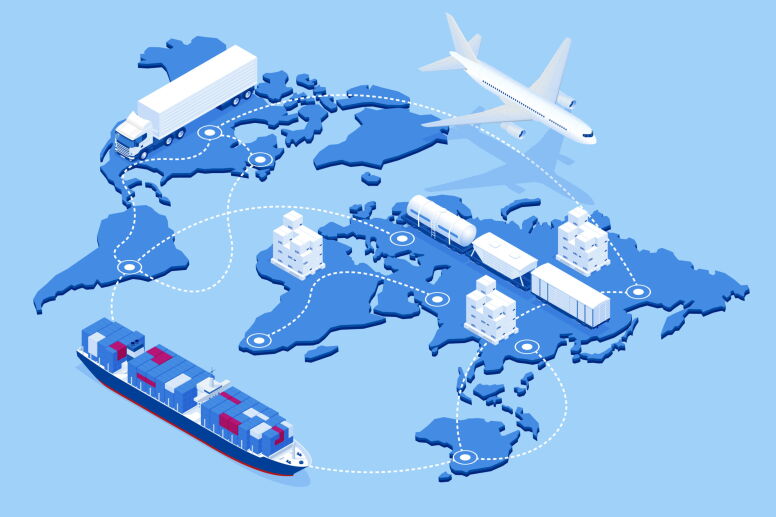
As COVID-19 rippled through the economy, global supply chains buckled. Companies around the world were hit by delays, inventory gaps and surging costs. Today, the immediate shocks of the pandemic have faded, but their effects continue to shape how businesses plan for and manage risk.
“The pandemic was unlike past disruptions — sudden, unpredictable, and truly global — but it’s just one of several we’ve seen in recent years,” says Vinayak Deshpande, the Mann Family Distinguished Professor of Operations at UNC Kenan-Flagler Business School.
“From trade tensions to natural disasters to port strikes and now an escalating tariff war, supply chain shocks are becoming more common and more severe. And businesses have to adapt.”
Deshpande’s new research helps companies do just that, offering a roadmap and practical lessons to help leaders build supply chains for a more turbulent future. He published his findings in “Restructuring Global Supply Chains: Navigating Challenges of the COVID-19 Pandemic and Beyond” in the Manufacturing & Service Operations Journal.
By analyzing detailed U.S. import data from 2019 to 2021, Deshpande and his colleagues identified macro-level trends in supply chain shifts. They also interviewed hundreds of logistics executives across sectors to uncover context behind recent changes.
Their findings highlight four key insights and implications for senior leaders.
The pandemic exposed the danger of relying too heavily on one region for supplies, prompting companies to diversify their supplier base.
Prior to the pandemic, many industries depended heavily on China for supplies. But in the years since, companies have started to rethink that strategy by moving some production to other countries, in particular India, Vietnam and Mexico.
Relying too much on a single region or supplier leaves companies vulnerable, says Deshpande. “That’s why many are moving toward a more diversified portfolio,” he says. “Essentially, they’re not putting all their eggs in one basket.”
His research shows that dual sourcing is becoming more common, with businesses securing two suppliers instead of one. This strategy only works, however, if those suppliers aren’t in the same place. Two suppliers in the same country or even the same region, doesn’t shield companies from risk if that area is hit by a crisis. The key is for companies to geographically spread out their exposure.
Managers learned they need to manage risks tied to individual suppliers and the countries where those suppliers operate.
When a company’s entire supply base is concentrated in one region, it’s vulnerable to all kinds of disruption. That holds true whether the disruption is a natural disaster like a hurricane or a man-made event like political instability or an on-again, off-again tariff campaign. As a result, many firms are working to source raw materials closer to their customer base or to where suppliers are already located.
In addition, rising geopolitical tensions mean that concepts like “friendshoring” — favoring suppliers in politically aligned countries — are gaining traction as ways to reduce risk.
“But even that approach is becoming harder to navigate for U.S. companies, as shifting alliances make it harder to identify which countries truly count as ‘friends,’” Deshpande says.
Companies reevaluated just-in-time inventory to better handle supply chain disruptions.
Toyota was one of the first companies to develop and embrace lean manufacturing. The idea is to keep inventory levels low — just enough to avoid delays but not so much that materials sit unused. This reduces costs and speeds up production.
“This approach works well when supply chains are humming along smoothly,” says Deshpande. “But the pandemic showed lean manufacturing’s weakness when everything ground to a halt.”
Many companies have realized that carrying some inventory acts as a buffer against disruptions. Meanwhile, ordering in bigger batches and less often can help cushion the impact of delays, he says.
Companies realized that disruption strategies aren’t one-size-fits-all.
Moving supply chains is one strategy to avoid breakdowns but isn’t feasible for every industry. The apparel industry, for instance, is not capital intensive and making changes is relatively straightforward. That is why many companies have already moved operations from China to Cambodia, India and Bangladesh.
But it’s a different story in the semiconductor industry, says Deshpande. “It’s highly capital intensive, requiring significant time, investment and skilled labor,” he says. “Building a fabrication plant can cost billions of dollars and make short-term shifts far more difficult.”
The upshot: Strategies need to be shaped by the demands of each industry.
Deshpande’s research suggests multiple avenues for further study. Perhaps the most pressing question is: How do senior leaders balance resilience with efficiency?
“Focus too much on efficiency, and your supply chain becomes brittle. But prioritize resilience and reliability, and costs rise, making products less affordable. There must be a sweet spot.”
In some ways, the pandemic was a wake-up call for companies, he says. “Covid was such a jolt that it pushed them to think differently. Many are now more alert to future risks.”