News & Stories
Making accounting relevant and applicable
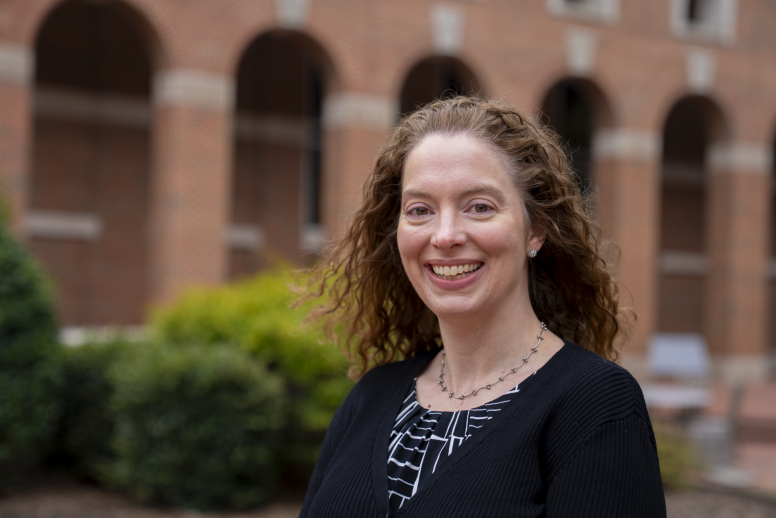
Margot Howard (PhD ’15) was on the fast track to a partnership at a major accounting firm when she realized the role wasn’t for her.
Instead of climbing farther up the corporate ladder, she returned to the classroom — first as a PhD student at UNC Kenan-Flagler Business School and now as a professor.
“I was just wowed by UNC Kenan-Flagler, I loved the environment so much that when a position opened up to come back there, it was too tempting,” she says.
It was a decision that set her career on a new course. Today, she is part of a growing cohort of UNC Kenan-Flagler faculty who trained at the Business School and later returned to teach. “I know there are at least four of us in the accounting faculty who got our PhDs at UNC. It’s not just me — it’s something in the water here.”
Howard’s story begins as an undergraduate, where an introductory accounting class at the University of Notre Dame proved unexpectedly decisive. “It just clicked for me,” she says. “It made sense in my brain.”
She earned a master of accounting degree at the University of Michigan and entered public accounting, working at Deloitte and quickly rising through the ranks. But after several years, Howard sensed that partnership — the ultimate goal for many colleagues — was not hers.
At the same time, the profession faced a shortage of academics. “It was clear a lot of accounting professors were retiring in the future without a pipeline to replace them, so the big firms were contributing money to help people go back and get their PhDs.”
Howard, who already had teaching experience, applied. After earning her PhD at UNC Kenan-Flagler she began her academic career at the College of William & Mary before returning to Chapel Hill to join the accounting faculty.
At UNC Kenan-Flagler, Howard’s teaching spans financial accounting for both Undergraduate Business Program and Master of Accounting (MAC) Program students, and income tax.
She is particularly proud of a MAC class she created in which students use what they learned in class to prepare and file federal and state returns for low- and middle-income taxpayers.
“It’s experiential: We do tax returns for people in the community,” she says. “Across all of those courses, I want students to always walk away from the class feeling that what they learned will help them in their real lives — not just an exercise in memorization that they forget once exams are over.”
The tax clinic course illustrates her broader philosophy: Knowledge should be relevant and applicable. “It helps them build their tax skills and interpersonal and communication skills as they work with the local community.”
Howard’s research interests are in tax and real estate investment, but teaching has always been her priority, and she leans into her role as a mentor.
Howard credits UNC Kenan-Flagler’s culture for fueling her enthusiasm. “We have extremely high caliber students, extremely interested in learning,” she says. “I love that excitement and engagement.”
She points to colleagues who support faculty-student initiatives, describing an environment that encourages experimentation and applied learning.
Looking ahead, Howard believes the accounting profession is undergoing wholesale change. Artificial intelligence (AI) is at the center of that shift. “AI is everywhere, and accounting is no exception,” she says.
Part of Howard’s role as an educator is to ensure students are ready for the AI era. She sees opportunities in automation: increasing efficiency and freeing accountants from “rote, monotonous activities” so they can focus on problem-solving. But she warns of the risks.
“I want students to proactively consider the potential for hallucinations and misinterpreted prompts as they decide how to incorporate AI into their work process,” she says. “Data security is obviously also a major concern in a lot of accounting work. We need to instill that in our students — now — so when they move onto those positions, they know how important these issues are,” she says.
She urges them to think of AI as more than typing prompts into a chat box. “It’s also about creating workflows and automating tasks.”
More broadly, asked what guidance she gives students preparing for careers in accounting, Howard points to flexibility. “A big thing is being open to different opportunities,” she says. “When I was in public accounting, I moved into a lot of different positions, which really has served me in my career.”
Her advice is to be intellectually curious and “be open and ready to change — and embrace it.”