Perspectives
The Real Risks in President Trump’s Iranian Intervention
Director’s Blog by Stephen V. Arbogast
One week into the joint US-Israeli strike on Iran’s regime, there have been numerous articles listing all the risks President Trump is taking and all the things that could go wrong. Without implying that these risks don’t exist, I’d like to put them in context. To an impressive degree, the administration has unfolded unanticipated plans with a reasonable chance of “success”. We will define that term, success, in detail below. Then I’d like to turn to the one true risk which has the biggest chance of closing down the operation on less that satisfactory terms – that is the energy security risk if the US cannot pry open the Strait of Hormuz for normal traffic.
Many critiques have been tossed at this operation: there is no clearcut goal, or there are several goals suggesting unclear objectives; there is no strategy for what is to follow the impressive ‘shock and awe’ from the air; there was no “imminent threat” justifying the recourse to arms and thus the attacks are illegal and unconstitutional. Most of these criticisms have received effective rebuttals elsewhere. For example, it has been pointed out that the War Powers Resolution of 1973 affords a President 60 days for such military actions, during which time he must report to Congress and after which he must obtain congressional authorization. The administration has complied fully with these conditions.
It is on the issues of objectives and strategies that useful clarifications can be made. This begins with the observation that this intervention is not only a combined US-Israeli operation but one that was jointly planned in advance. This mission also has a ‘staircase of objectives.’ The US and Israel are seeking a set of outcomes which collectively will define ‘success’ for their military actions. These rise in terms of ambition but also in terms of difficulty and complexity to achieve. Whether this staircase can be climbed ultimately depends on one external constraint: the stability of global energy markets
On the first step is the minimal objective which is best described as ‘mowing the grass.’ This term arose after the Israel-Iran exchanges of last June. Commentators then wondered what would prevent the surviving mullah regime from rebuilding its missile arsenal and nuclear capabilities. The Israeli answer was to put it out that they would pre-emptively strike again. This they described as ‘mowing the grass.’ By returning to strike Iran’s missile arsenal and selective nuclear targets a mere 7 months after last time, the US and Israel deliver on their promise that Iran’s regime will not be allowed to rebuild the capabilities which previously threated the entire region.
The second step on the staircase can be described as ‘opening the door to new leadership.’ Iran’s efforts to reconstitute its missile capabilities/uranium enrichment potential and its stout refusal during negotiations to give up nuclear enrichment convinced the administration that a Khamenei-led regime was irreconcilable and untrustworthy. Decapitation then became the recommended solution. Israel showed the capacity for doing this last June. Then they targeted and executed numerous high ranking Iranian military and intelligence figures. What stood out was Israel’s intelligence capability – they knew exactly where these figures were at the moment when they chose to strike.
This time around Israel and the US went for the top. Supposedly the time for action was determined by intelligence indicating that many leading figures, including Khamenei, had gathered. Khamenei has since been reported as killed by Iran’s state media, and other leaders were likely killed as well; nobody knows how many regime leaders are now dead, but the reality of a substantial decapitation seems to have been achieved. The ability of the remaining leaders to command, control and coordinate has also been compromised. Those who survive now see political space above them and devastation all around. Invitations and incentives to move up and change Iran’s course have been delivered.
The staircase third step involves ‘neutralizing Iran’s ability to strike back’. Much has been accomplished here. The Iranian navy has been severely degraded; its missile arsenal also is depleted having suffered attacks on launchers and storehouses and having fired much of its inventory. The number of Iranian missile attacks has declined daily. Iran also seems to have little remaining air defense. The only reported US jets lost were the result of Kuwaiti friendly fire. However, Iran has succeeded in effectively shutting the Strait of Hormuz to tanker and LNG carriers. This is the single Iranian ‘success’ of consequence, and it has the most promise of disrupting the US-Israeli strategy. We will deal with this at more length below.
The fourth step is to ‘establish the US as the arbiter of Iranian economic revenues’. This also has been accomplished. The US is now in position to blockade Iranian oil supplies for some time. That potential always existed but previous administrations never committed naval forces to enforcement; sanctions of various sorts were tried but Iranian oil exports were never reduced to negligible levels for any length of time. Now they are and, with the administration having crossed the threshold of using deadly force, it can sustain the blockade of Iranian exports. As in Venezuela, this puts the administration in a position to reward or severely punish whatever regime coalesces in the wake of Khamenei’s demise.
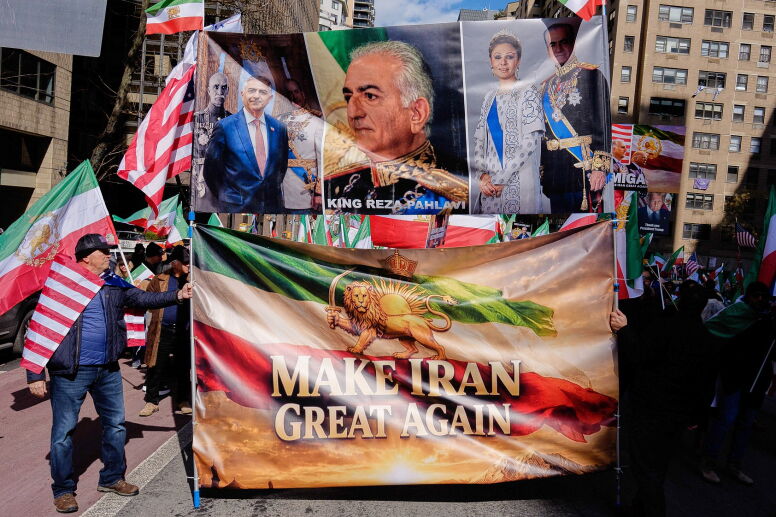
The highest rung on the goals staircase is ‘regime change’. This objective has several variations, and the President’s musings about them has contributed to impression of moving goal posts. Regardless of the charges of strategic incoherence, there are three outcomes which the administration would regard as a major improvement over the Khamenei-led theocracy. A return of the former Shah’s son, fueled by a popular uprising would be welcomed. Israel’s targeting of the regime’s repressive forces, e.g. the Revolutionary Guard, aims at enabling popular resistance to overwhelm whatever anti-uprising forces survive. The second outcome would be the supplanting of Khamenei-style hardliners with regime elements open to a new deal. President Trump has dangled his terms in public – a complete end to uranium enrichment and to support of proxy forces across the region. It remains to be seen whether a Delcy Rodriguez replica can be found among the regime survivors or the Iranian military. A third outcome, messier but still acceptable, would be Iran’s fragmentation. Setting the Iranian Kurds loose along with other restive minorities has launched this possibility. The administration can use these elements to promote full regime change or provide leverage for an acceptable deal. They also seem prepared to let Iran fall to pieces, the idea being that any successor government in Tehran would be consumed for some time with domestic struggles.
This review suggests the Israeli-US effort lacked neither objectives nor strategy. Much has been accomplished towards achieving several goals. Obstacles clearly remain however; one in particular, a sustained closing of the Strait of Hormuz has the potential to seriously upend these efforts. This is the one thing Iran has accomplished that could force the US and Israel to accept terms well down the staircase outlined above. It is also an issue where the interests of the US and Israel may diverge.
Some 18 million barrels per day of crude oil plus all of Qatar’s substantial LNG exports move through this passageway. At its narrowest point, the Strait measures 21 miles across. However, the traffic lanes effectively measure at 6 miles – 2 outbound, 2 inbound and a 2-mile buffer zone. In logistic terms, this is a perfect example of a choke point.
There have been prior episodes of attempts to close the Strait. During the 1980s Iran made attacks on shipping. Several means were used: mines, speed boat swarms and missiles featured prominently. These attacks prompted US efforts to convoy ships through the passageway, and the energy shock threat was largely neutralized. That said, what the US fears today and what Iran hopes for, is enough threats to shipping that insurers jack up rates to sky high levels. This can cascade into cancelled charters, stranded shipments and a material shortage of crude oil and natural gas on global markets.
Saudi Arabia and the UAE have some capacity to reroute supplies to the Red Sea and the Mediterranean. Physical re-route measures lie somewhere between 5-8 MB/D, though actual spare capacity may be less. This means an effective shutdown of the Strait would leave global markets with something like a 10+ MB/D shortage. As of today, March 7, 2026, over 500 crude and LNG tankers are idling in the Persian Gulf. Reportedly another 100 tankers are waiting outside the Strait.
Could the US again organize convoys to reopen the Strait? The idea has been mooted publicly but thus far has failed to coalesce into action. Here we enter a realm of speculation as to why this is so. Both physical convoying by Navy ships and a provision of marine insurance have been floated as potential US plans. The US has offered ‘sovereign insurance’ to shippers in the past, to good effect. This worked well in circumstances where the Navy was able to protect shipping and limit losses to negligible levels.
The guess here is that they have not come to fruition because the Navy is uncertain as to whether it can forestall large-scale drone attacks. These are harder to preempt, being launched suddenly from trucks or planes, and if several get through multiple tankers could be set on fire. This might scare the rest even if they have US insurance. Mines also remain a threat. Even with its navy in ruins, one or two Iranian speedboats could drop mines in the Strait. A time-consuming clearing action would then be required. Finally, even if unmolested a convoy system can only put 1-2 convoys daily through this passageway.
Without definitively securing the Strait of Hormuz, the global oil market would look at something like a 5-8 MB/D supply shortfall and a natural gas shortage as well. China, India, Japan and Korea will be the largest oil sufferers; both Europe and Asia will see surging LNG costs. There are inventories, strategic oil reserves, some spare production capacity and ‘oil on the water’ to buffer the threat of physical shortages. These will defer the threat of physical shortages for some time, probably measured in weeks. However, they have not prevented prices from rising sharply as traders hedge the possibility of more severe outcomes. Given all of this, if the Strait are not reopened, many countries will start pressuring the US and Israel to reach some sort of accord that restores normal supply. Their pressure will be reinforced in the US by affordability concerns and Democrat criticisms that start to look more prescient.
One ambiguous element in this picture is the role of China in any Strait’s closing. China today purchases roughly 40–45 percent of the oil that normally transits the Strait of Hormuz. Much of Iran’s sanctioned crude already has flowed quietly to Chinese refiners through a “dark fleet” of tankers operating outside normal insurance and tracking systems. Yet Beijing has little interest in seeing the Strait closed for any extended period. China’s economy depends heavily on Gulf oil supplies from Saudi Arabia, Iraq and the UAE, not just Iran. A sustained disruption that removes even 5–8 million barrels per day from global markets would send oil prices sharply higher and threaten Chinese economic growth. While offering Tehran rhetorical support, China may yet prove a quiet force for securing a settlement to the conflict. Their eyes and ears on the ground and proximity to surviving Iranian leaders may enable them to promote a deal acceptable to the US and Israel.
That said, a plan for the Strait of Hormuz is starting to look like the one aspect of this military campaign that was not pre-planned. This impression arises from 1) the fact that the Strait are now effectively closed and 2) the administration’s failure up to now to implement an effective remedy despite recognizing that one is needed. In retrospect, this should not have happened. There is plenty of history, to say nothing of obvious geography, suggesting that closing the Strait was a potential Iranian trump card. Where then is the effective pre-emption or ready reaction?
If drones and mines remain the biggest threats, it may take ground forces to secure the potential launch sites. This may be the sticking point for the Trump administration. Committing US ground forces, even in a limited hold-territory action, has been a red line for Trump and his coalition. Are they stuck here?
This administration has shown considerable ability to improvise, and it is not out of the question that the pain inflicted on Khamenei’s survivors is such that a deal acceptable to the US and Israel can emerge. However, a clock is now ticking. Either the US and Israel must implement both the military and the financial measures needed to reopen the Strait of Hormuz or the Iranian rump government must effectively capitulate. Otherwise, the shock to energy and oil markets may reach a point where the US and Israel must descend the staircase of goals and largely be satisfied with having ‘mown the grass.’