News & Stories
Finding meaning in work, joy in teaching
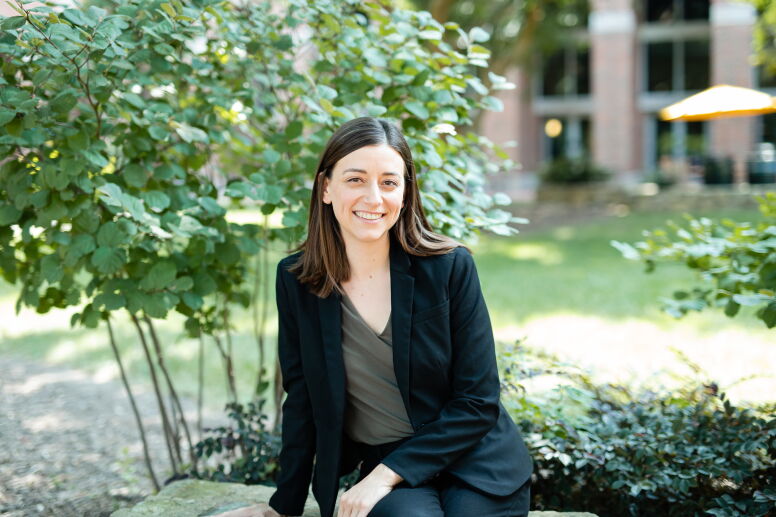
College campuses buzz with energy as young people figure out how they want to contribute to the world. Professor Laura Sonday discovered a way to channel that dynamism in an innovative class project.
Sonday teaches the Undergraduate Business Program core course “Leading and Managing,” which prepares students to become more effective leaders and teammates in their careers. As part of the course, students complete “50 Lives Forward,” an experiential learning project she designed in which teams apply course concepts to advance a United Nations Sustainable Development Goal.
Student groups convinced people to quit vaping, persuaded 50 people to obtain their CPR certification, taught classmates how to open brokerage accounts for their future financial health and raised money to help kids in disadvantaged neighborhoods pay for college entrance exams.
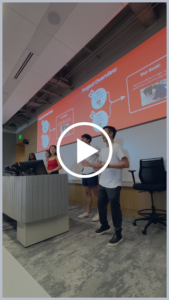
One group broke the record — twice — for registering the most potential bone-marrow donors at UNC in a day. While collecting cheek swabs for the registry, they were visited by someone who benefitted from a transplant and lauded them for their work. Collectively, 150 students raised $5,918.39 for charity, inspired 202 people to volunteer locally and persuaded 721 people to change their own behavior for the better.
“What I appreciate across all these examples is that the students are identifying real problems — some of which we don’t talk about nearly enough — and then designing interventions that are grounded in the skills we discuss in class,” says Sonday. “They’re learning — in very hands-on ways — how hard it is to get people to change their behavior and how powerful it can be when they succeed.”
Sonday’s inspiration for the “50 Lives Forward” project was fueled by Erin Long, a fellow organizational behavior professor at UNC Kenan-Flagler, whose students raised money for charity as part of a class project, and Jerry Davis, a former professor at the University of Michigan, where she earned her PhD, who routinely encouraged students to get involved with the United Nations Sustainable Development Goals, which aim to end poverty, protect the planet and ensure peace and prosperity by 2030.
Sonday decided to combine these two projects and have students convince 50 people to modify their behavior to create meaningful change.
“Never did I think that our class concept would relate to something in person and in life in such a tangible manner,” says Gabe Villar (BSBA ’27).
The experience and lessons extended beyond business concepts.
“You know, there are good people out there, and people love Carolina and they love others and this was an opportunity for them to show that,” says Wes Spykerman (BSBA ’27).
“A lot of the magic that happens in the classroom comes from the students themselves,” Sonday says. “What we’re really trying to do each semester is create loving communities where people can learn and grow. That’s not something I can do on my own. It requires everyone’s participation and willingness to show up for each other, and witnessing the students develop that kind of community over the course of the semester is very inspiring.”
Work and life
Sonday also has a novel approach to research, relying primarily on interviews and ethnographic observation to develop new insights on identity, meaning and leadership in organizations.
She wrote her PhD dissertation on the Financial Independence, Retire Early Movement, known as FIRE, a community focused on helping people achieve financial freedom from work.
“FIRE initially caught my attention because its followers openly grapple with a question that seems to beset our era: How do you make a living while also creating a meaningful life? The question is made all the more difficult to answer amid rising economic volatility, increased pressure to love your job, and the persistent influence of the ideal worker norm.”
Her dissertation is now a paper: “Work Optional”: The Adoption and Enactment of a New Work Ideal in the Financial Independence Retire Early Community,” published by Administrative Science Quarterly. She shares how community tactics in the FIRE community fostered a “new work ideal” — a novel aspiration for what constitutes an optimal work life — and why that ideal varied in its transformative impact.
“I think the findings are relevant not only for those who study meaningful work, but also for anyone who has ever felt that their life choices were conditioned by financial concern,” she says.
Her work has caught the attention of the business media, notably a full feature in Business Insider.
In a more recent project, Sonday is collaborating with doctoral students Shveta Kaul (PhD ’28) and Riddhi Shelat to look at how the work someone produces, such as a book or music, becomes meaningful to other people and how that meaning can change when the public learns something troubling about the creator of that work. The team has interviewed 72 people who expressed deep admiration of someone else’s work, only to find out that these individuals (actors, religious leaders, scientists, etc.) engaged in some kind of immoral behavior, ranging from plagiarism to murder.
“We are trying to understand if and when the art transcends the artist, so to speak. We’re finding that there is no easy answer; people really wrestle with these situations and not everyone responds in the same way,” says Sonday.
In their analysis, they identified several narrative elements that help people preserve the meaningfulness of the work despite their feelings about the creator, and the narrative elements that correspond with feeling that the meaning of the work has been irreparably destroyed.
“We also are exploring how people subsequently shift their engagement with the work to reconcile their ambivalence,” she says. The team ultimately hopes to contribute new insights on how work is reevaluated in the presence of moral taint.
Finding joy
Teaching UBP students brings joy to Sonday and her students recognize her dedication to them. She received the 2026 Chancellor’s Undergraduate Teaching Award for her ability to make complex ideas accessible, her unwavering positivity and her commitment to keeping students engaged.
This University-wide award is especially meaningful because students nominate and select who receives it. “Knowing that students value and appreciate what I’m doing in the classroom, and that they feel they’re getting something out of it, means so much to me,” says Sonday.
“I think what makes UNC Kenan-Flagler a great place to work is the sense that we have an opportunity to help each other learn and grow,” says Sonday. “I like being part of communities that are striving to bring out the best in people, and this is one of those places.”
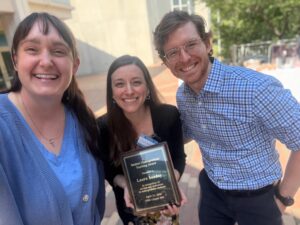
Friends Audrey White, who works in financial aid at UNC, and Caleb Easterly, an MD/PhD student, celebrate Sonday’s teaching award.