
Skip to content Skip to Programs Navigation

Calendar

Family Enterprise Center Masterclass Series Banner

Equipping Families to Lead, Align, and Thrive Across Generations

Program Overview

The Family Enterprise Center Masterclass Series is a learning journey for families who own and lead enterprises.

The nine‑module learning experience is designed to strengthen the capabilities of family enterprise leaders, owners, and rising generation members. Grounded in research and decades of practice with family firms, the Masterclass Series provides a structured pathway for families to learn together, build alignment, and steward their enterprises across generations.

Delivered over a three‑year cycle, the series includes three modules per year, each consisting of two highly interactive 90‑minute live Zoom sessions. Participants explore essential frameworks, apply tools to their own family enterprise, and engage with UNC faculty and expert guest speakers.

Each module is stand‑alone and requires its own individual registration. Families should sign up for the modules that fit their learning needs. Each module includes videos, podcasts, and supplemental materials to support participants ongoing learning.

Who Should Attend?

This course is a good fit for those who are in the following situations:

  • Family business owners and shareholders
  • Next-generation family leaders
  • Spouses of owners and family leaders
  • Non-Family executives working closely with family owners

Delivery and Format

Icon of screen with virtual live meeting and chat

Live Zoom Sessions

Icon of a video on a screen

Virtual Asynchronous Materials

Learning Outcomes

  • Analyze the structure and dynamics of family enterprises by differentiating them from other business models and evaluating how family, ownership, business, and individual systems interact.
  • Design and evaluate governance systems that clarify roles, authority, and decision rights while improving alignment and reducing conflict.
  • Demonstrate responsible ownership by applying financial literacy, understanding owner rights and responsibilities, and using tools to sustain alignment across owners.
  • Formulate strategic approaches that balance long-term stewardship, innovation, and family values to support sustainable enterprise growth.
  • Develop structured succession plans that prepare future leaders, manage transitions effectively, and support long-term continuity.
  • Create development pathways for next-generation members that build capability, credibility, and readiness for diverse roles within the enterprise.
  • Apply communication and conflict management strategies to strengthen trust, improve relationships, and navigate complex family dynamics.
  • Evaluate and design policies and agreements that reduce ambiguity, align expectations, and support both business performance and family relationships.
  • Construct a roadmap for multi-generational continuity by integrating evolving family dynamics, governance, and shared legacy into long-term planning.

Curriculum

2026

Family Enterprise Fundamentals

Ownership in the Family Firm: Roles & Responsibilities

Strategy in the Family Firm

Family Enterprise Fundamentals 
April 21 and 29, 2026, 12:00 – 1:30 pm ET, led by Cooper Biersach and Steve Miller
Participants will explore the essential frameworks and conversations that help family firms align, make better decisions, and sustain both business performance and family relationships over time.

Ownership in the Family Firm: Roles & Responsibilities
May 27 and June 2, 2026, 12:00 – 1:30 pm ET, led by Cooper Biersach and Steve Miller
Participants will explore the role of owners, primary ownership responsibilities, and the creation of an owners strategy that includes a defined shared vision, aligned ownership priorities, and measurable goals. This module will include a focus on the impact of ownership strategy on business strategy.

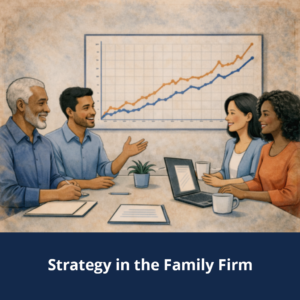
Strategy in the Family Firm 
September 15 and 29, 2026, led by Steve Miller
Participants will explore how strategy works differently in family enterprises—how owner goals influence growth, how competitive advantage is built, and the role of culture in execution.


2027

Family Dynamics & Building Trust

Communication & Conflict Management

Governance & Decision-Making Structures

2028

Succession Planning & Leadership Transitions

Next‑Generation Development & Pathways to Leadership

Legacy & Wealth Preservation