Perspectives
Rethinking Fashion, One Thread at a Time: The Philosophy Behind Umber and Ochre
How Umber and Ochre is challenging overproduction through craft, community and regenerative design.
In an industry obsessed with production speed and volume, Kunal Desai founded a brand based on the exact opposite: only make what you can sell, use materials that matter and preserve traditional art forms on the verge of disappearing. This form of slow fashion breaks the surface-level “trendiness” we see on social media, and it works because Desai is actively solving an issue seen in the fashion industry for decades. Rooted in a deep understanding of textiles and a commitment to sustainability, “at the highest regard,” his brand challenges the industry’s cycle of overproduction by turning to slow-fashion clothing made with intention. From his early exposure to India’s textile production to building a brand grounded in earth-based materials and traditional techniques, Desai’s journey reflects a shift towards fashion that values the product and the process.
Origins:
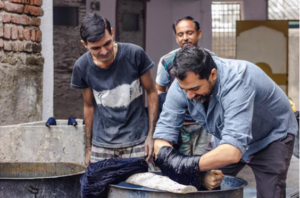
Founder Kunal Desai hand-dying yarns and collaborating with local natural dye producers.
Kunal Desai has always considered himself an entrepreneur at heart, but this foundation was built much earlier, in his family’s textile production house in Mumbai, India. Growing up around the Indian textile industry, Desai gained an early understanding of how fabrics move from soil to finished product.“That was the platform they provided,” Desai said. “From there, I carved out my own niche.”
After moving to the United States, he began his own production house in 2002, sourcing fabrics such as organic cotton, recycled polyester, recycled nylon, hemp and denim across the country. However, over time, his role as a producer shifted into a passion for design. He considered himself “a product person more than a brand person.” He was drawn to the challenge of bringing ideas to life through technical expertise and design manipulation. Then, around 2008 and 2009, Desai joined the Academy of Art University to pursue a Master’s degree in Fashion Design; he wanted his own brand. But he never finished the degree. Instead, he left school to focus on building Umber and Ochre with Academy of Art graduate Gerhart Hinse—a brand that would become the antidote to everything he’d witnessed in his first business.
Originally, Umber and Ochre focused on US-based manufacturing and production. But something felt off to Desai, “it [the mission of the brand] was not resonating with me.” This disconnect inspired him to rethink not just where his products were made, but how and why. This shift ultimately defined the philosophy behind Umber and Ochre.
Moving to India:
To Desai, U.S. production always felt borrowed. “I, having Indian origin, born and brought up in Mumbai; I could not connect with it and differentiate the product and myself.” That disconnection pushed him back toward something he had grown up knowing but never fully examined: hand-spun, hand-woven natural fabric, the kind of textile that had been part of Indian life for centuries.
Hand-spun cotton has always been a part of India’s cultural and economic fabric. Once a staple of everyday life and a symbol of self-reliance during the independence movement, it stood in direct contrast to industrial mass production. For Desai, handspun, hand-woven cotton garments offered not just a connection to his roots, but a clear alternative to the speed and scale of modern fashion.
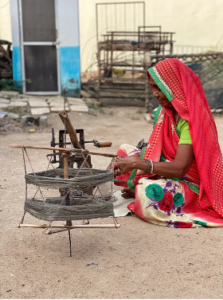
Cotton threads are woven manually on a traditional wooden hand loom with a weaver’s bare feet and hands. This is an extremely slow process that creates durable, made-to-last textiles, and each product is unique to its own because of the deliberate manual process. Each day, a weaver typically averages looming six meters of fabric.
He uses the analogy of rediscovering a food from home: “You feel different when you eat a South Indian Dosa versus a French crepe, even though by concept the two dishes are similar.” The fabric, texture, history and culture of handspun, hand-woven fabric resonated in a way that wax cotton never did.
Hand-woven, hand-spun natural fabrics are produced without any chemicals and become softer with each wash. Beyond their components, these fabrics solve a problem central to the fashion industry: overproduction. “We don’t need to run minimums,” Desai explained. “We can just produce as we want, because it’s handwoven.” That single quality made the entire small-batch model possible. No minimums meant no overproduction, no excess inventory, no pressure to discount. With this realization, Umber and Ochre moved production to India, and their philosophy began to become a reality.
The Living Crafts:
A central focus of Umber and Ochre’s identity is their commitment to saving Indian traditional craft forms that are on the verge of disappearing. These art forms and techniques are individualized to specific regions and communities, where if the art form disappeared, so would a community’s livelihood.
The most striking example is Rogan Art, which originated in the Kutch region of Gujarat, India. There are only two families left in Kutch that practice Rogan Art. This art form is completely hand-drawn and goes directly onto the garment, with the natural pigments made by combining the pigment with castor oil and using the heat of the artist’s palm to melt the colors onto the fabric. It then cures naturally. “It’s something far beyond,” Desai said of the first time he saw it being made in person, during his travels through Kutch. “Only a handful of them exist with this art, and that’s what really drove me.”
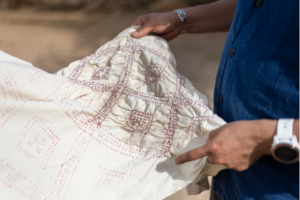
Bandhani is an ancient Indian textile art form that uses resistance dyeing. It originates from Kutch and involves pinching small portions of the fabric and tying them tightly with waxed thread before dyeing (as seen in the photo). This specific art style is credited to the Khatri community in Kutch.
The same philosophy extends to other art forms that Umber and Ochre focus on, such as Chinkankari embroidery, Ikat, Jamdani from West Bengal and block-printing techniques from Machilipatnam
in Andhra Pradesh, Hyderabad and Jaipur. Each form is rooted in a specific geographic region, community and a specific set of hands.”We go to them,” Desai said. “They don’t come to us.”

Umber and Ochre partners with family-run natural dyeing facilities where dyes are made with natural pigments and minerals. Handspun yarn is hand-dyed at these facilities using a combination of indigo (blue), madder (red), chebula (black), and pomegranate (yellow) pigments. This natural process makes each batch of yarn unique.
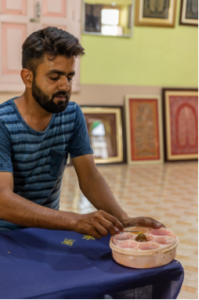
Rogan Art is an ancient art form from Kutch, Gujarat, India, that uses a sticky paste made with minerals and castor oil to draw directly on fabrics. One extended family split into two families in Kutch practices this technique. Pictured is one of the artists drawing a Rogan design onto fabric. As a dying art form, Umber and Ochre aims to preserve it by incorporating Rogan Art in their designs.
However, with Chinkankari, Desai has noticed the art form becoming commercial without proper care. Larger brands have scaled these techniques using thicker yarns and faster methods, and while that has created broader visibility for the art form, it has also eroded the quality. Finer work requires more hours. More hours mean higher costs. And when the market won’t pay for the time, the craft simplifies itself into something else. Umber and Ochre push back on this issue by keeping their designs abstract; nothing is repeated to honor the hands that have made them. The brand’s belief that every piece is made by a person drives their values.
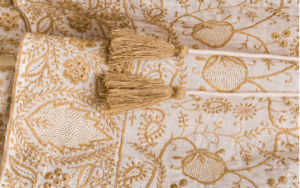
Chinkankari, which originates from Uttar Pradesh, India, is an ancient art form that uses intricate hand embroidery. Chinkankari weavers, typically women, work together on pieces to hand-knot the threads onto lightweight fabrics like cotton or muslin. One panel of a typical Chinkankari apparel piece takes fifteen days to complete and features details such as floral vines and paisleys.
One weaver in Kutch who partnered with Umber and Ochre had two looms before the partnership. With their sustained partnership, this weaver now runs thirty, increasing employment in the Kutch community to weave, spin and dye yarn. He’s gained his self-respect back,” Desai said simply. “Commitment to continue the art and trade — that’s what changed.”
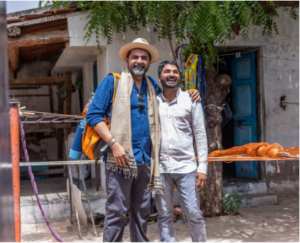
Founder Kunal Desai with a local weaver in Kutch, Gujarat, India, a somewhat remote region known for its nomadic lifestyle, traditional textile art forms and production of Kala Cotton (a type of cotton that can grow without a lot of water and has great heat resistance).
From Soil to Finished Product:
Umber and Ochre’s core philosophy begins with not the process of creating the product, but with the soil process. Through partnerships with Raddis Cotton, the brand works directly with farmers in high-rainfall regions like Odisha, where cotton can grow without irrigation or chemical inputs. Instead of relying on pesticides or synthetic fertilizers, farmers are supported with non-GMO seeds and education around soil health and crop cycles.
But the real shift is economic. “They have a secured sale,” Desai explained. “If they’re not able to sell, then we will buy it off.” That guarantee fundamentally changes a farmer’s reality. Before transitioning to regenerative practices, many farmers operated under intense financial pressure where they were taking out loans just to purchase seeds, often at interest rates as high as 50 to 70 percent. Failed crops or unstable market prices could trap them in cycles of debt, and before programs such as Umber and Ochre’s, many Indian farmers were part of the debt trap. Daily life for many farmers was defined by uncertainty: long hours, rising input costs and little control over pricing. The transition to regenerative farming not only reduced financial stress but also restored a sense of dignity.
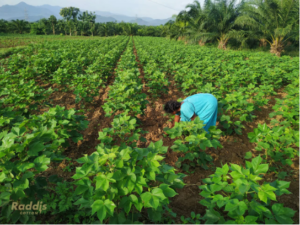
A regenerative cotton farm in Andhra Pradesh, India where crops are treated without pesticides, GMO seeds and rely on rainfall for water to reduce water usage waste. All the crops are diversified through intercropping; farmers will plant cotton, corn, marigolds and chilis to create a ecosystem where no toxic chemicals are used, improving soil health and encouraging crop rotation.
With each partnership between a farmer and Umber and Ochre, farmers are paid a premium for their cotton, given access to farming education resources, and supported through the process of gaining organic certifications. In the past four years, sixteen farming families have made this shift.
That impact is also measurable. Through its Seed&U program in collaboration with Raddis Cotton, the brand has helped sequester nearly 39 tonnes of carbon emissions, conserve over 20 million liters of water, and eliminate thousands of kilograms of chemical inputs, including 7.7 kilograms of toxic pesticides and 1,775 kilograms of synthetic fertilizers. The initiative now supports the financial independence of roughly 40 households, impacting up to 200 individuals, each working on small landholdings of just a few acres.
Families who once relied on chemical farming practices are now improving soil health, increasing yields and generating more stable, year-round income through crop rotation. “They’ve gone from mud homes to concrete homes. Education levels have improved.” To Desai, sustainability is more than just a label; it’s about improving the land and livelihoods within the systems that make sustainability a reality.
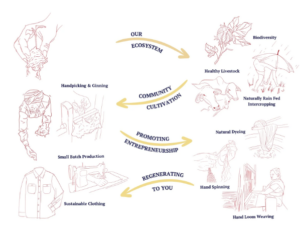
The Seed&U program, a collaboration between Umber and Ochre and Raddis Cotton, utilizes naturally rain-fed intercropping and traditional artisanal crafts to eliminate toxic chemicals while isolating carbon and conserving millions of liters of water.
From Field to Store:
While the production process is rooted in India, Desai sees the value in consumer experience as well. Most Umber and Ochre apparel is accessible through their website, but the store in San Francisco embodies the brand’s promise and future.
“Every person who walks into the store… feels instant connection with the farm and field,” he said. The sensory connection is almost immediate. “They’ve never seen such fabrics and colors,” Desai said of customer reactions. Customers are often struck by the different textures, colors and irregularities in each of the designs on the racks. They can see and feel the hands behind each piece.
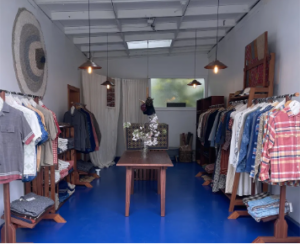
Umber and Ochre’s San Francisco store, which features a variety of their textiles and apparel.
Looking ahead, he envisions bringing the production process directly into the retail space by inviting artisans to demonstrate weaving, block printing and other techniques in real time. The goal is to collapse the distance between maker and consumer, turning what is usually invisible labor into something tangible.
That emphasis on physical connection also reflects a broader challenge within the brand. “The hardest part is the sales.” Despite heavily investing in supply chain integrity with fair wages, regenerative cotton and small batch production, the community’s values to consumers remain a challenge. “People don’t see the value in the product,” he said. “We invested in supply chain… but communication is something we’re still working on.”
Looking Ahead:
Rather than scaling up production rapidly, Umber and Ochre are focused on refining their model. At its core is hand-spun, handwoven cotton, but Desai sees room to expand into other natural fibers such as hemp, linen and silk, while maintaining the same principles of small-batch, human-centered production.
Transparency is another area of focus. While tools already exist to trace garments back to individual farmers and artisans, fully integrating that level of visibility into the brand’s operations remains a work in progress. For now, the challenge is balancing ambition with reality. Sustainability requires intention and financial stability. “The brand can only exist and perform those actions as it exists,” Desai said. He sees the future of fashion not with speed or scale, but by building a system that can sustain itself without compromising its values.
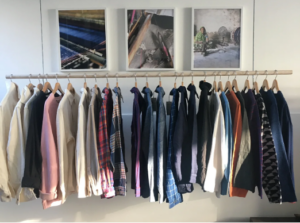
Umber and Ochre’s San Fransicso pop-up shelf from 2020 featuring their seasonal collection made from naturally hand-dyed cotton and wool fabrics.
Desai and Umber and Ochre’s story began as a textile production house, but has now evolved to something far larger than fabric. The brand has connected farmers, artisans and consumers into one system where every hand matters and each step is done with intention.
“If every brand figures out why their product needs to exist,” he said, “then you’ve got a brand.” For Kunal Desai, that purpose is rooted in India; in the farmers, artisans and traditions that first shaped his understanding of textiles. Through Umber and Ochre, he is not just building a business, but returning to those origins, translating them into a model that is both sustainable and enduring.
Photos Courtesy of Kunal Desai and https://www.umberandochre.com
Author: Mahati Desabhatla