Perspectives
From Tradition to Timeless: Limma Ali’s Vision for Sustainable South Asian Jewelry
Growing up, Limma Ali had two choices: either wear real gold or silver that was expensive and difficult to style for her Eid functions or buy beautiful, yet low-quality, jewelry that would irritate her skin. This gap inspired her to create her own jewelry brand, Ataro, which solves both of these issues. Today, Ataro Jewellery is redefining what modern South Asian jewelry looks like while balancing heritage, sustainability and everyday luxury.
Childhood Dream Turned Reality:
Ever since Limma was seven, she has known exactly what she wants to be–a fashion designer. Her vision board explained it all: attend the University of Leeds to study fashion, intern at a couple of companies and go on to become a Senior Designer at Paul Smith. Once she achieved every goal on that board, she found herself asking a new question: What’s next? “Once I achieved that,” Limma said, “I felt like I was ready for the next chapter.”

Limma Ali, Founder of Ataro Jewellery
By then, she had spent nearly eight years in luxury fashion, working across tailoring, jersey design and runway collections. Launching Ataro wasn’t about leaving fashion behind, but about applying the skills and principles she mastered in luxury design to something new. Entrepreneurship also felt like a natural possibility because of Limma’s father. She grew up watching her father run his own business, building something for himself after immigrating from Bangladesh. He advocated for having your own brand, business and income. This instilled in her the belief that creating something of her own was achievable.
“My dad had his own business, so entrepreneurship always felt possible.”
After brainstorming what kind of business she wanted, Limma found that jewelry became the perfect extension of her creative identity. After years of designing for other brands, Limma launched Ataro in November 2025 following extensive research into cultural traditions, historical references and the significance of jewelry across South Asia. Today, Ataro is still very much a one-woman operation. Limma oversees nearly every aspect of the brand herself. From designing each collection and directing photoshoots to marketing, content creation, customer communication and creative strategy. Every collection has brought new lessons, requiring her to balance her creative vision with the realities of entrepreneurship.

From concept to photoshoot direction, Limma manages all aspects of Ataro Jewellery herself. Her recent Nila Nazar collection shoot is inspired by the regal ornamentation of Persian styles and the timeless elegance of Bengali heritage.
Using Her Identity as Inspiration:
Growing up in the north of England, Limma was one of the only South Asian children in her community. Her father owned a curry house, and as one of the few Bangladeshi families in the area, they often stood out. Like many children navigating multiple cultures, she spent much of her childhood wanting to blend in rather than celebrate what made her different. On one side, her Bangladeshi roots connected Limma to the world of Bollywood, Jhumkas and fashion staples like Salwar Kameez sets and encouraged her to keep in touch with her language. Her Western surroundings, on the other hand, gave her pop culture classics like One Tree Hill and Friends, as well as the people she grew up around.
For years, that desire to assimilate shaped how she saw herself. She describes herself as a self-proclaimed tomboy, someone who never felt particularly drawn to jewelry or outward expressions of femininity. Instead, much of her energy went toward trying not to stand out.
University became a turning point where she began exploring and embracing the different parts of her identity. She began seeing her culture as a collection of the influences she grew up around. Moving to London further expanded this perspective. As a city that was known to be a “melting pot of cultures,” London introduced her to new forms of art, food, fashion and creativity. Late-night gallery visits, vintage stores and local events became sources of inspiration for Limma’s identity. Rather than choosing cultures, she began embracing both her Bangladeshi heritage and British upbringing, seeing them as layers of her identity rather than something divided.
“My coming-of-age story is basically me finding myself and being really confident in mind and with who I am, because that’s what makes you special and unique.”
Jewelry became a part of this journey as it became more meaningful. “Jewelry became a way for me to express my femininity and my cultural identity because I was such a self-proclaimed tomboy growing up,” Limma said. What had once felt like an accessory became a way to reconnect with her heritage and bridge all the experiences that had shaped her. This realization would later become the foundation of Ataro. The brand represents the reality of growing up between cultures and not only finding confidence in each part but celebrating them too.
“I think what makes you special is being all of those things.” – Limma on embracing the various layers of one’s identity.
From Personal Frustration to Purpose:
For Limma, the idea for Ataro didn’t begin with a business plan; it began with an issue in her everyday life.
Every year, as Eid approached, she looked forward to wearing clothing that reflected her culture and celebrating one of the most important occasions in her religion and community. But the right jewelry for each outfit was another story.
As someone with sensitive skin, Limma only had two options: either wear real gold, which was expensive and less versatile to pair with other jewelry or buy beautiful, yet low-quality pieces. The affordable jewelry would irritate her because of the materials used in metal posts and plating. After understanding the gap, Limma asked herself one question: Why wasn’t there a middle ground?
The problem wasn’t just affordability. It was access. The jewelry available to her often forced customers to choose between cultural representation, quality, comfort and price, as though it were impossible to have all four. For Limma, that compromise didn’t make sense. “I wanted women to have healthy options that didn’t break the bank,” and drawing on her background in luxury fashion, she began imagining what an alternative could look like. This was the base inspiration for Ataro, a brand inspired by South Asian traditions, crafted with high-quality materials, designed for sensitive skin and priced to be accessible enough for everyday wear.
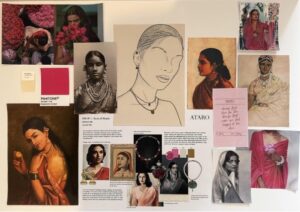
The vision board for Ataro’s debut Rani of Hearts collection, inspired by South Asian femininity, the royal color Rani Pink and timeless heritage jewelry.
Most importantly, she wanted to change when people wore her jewelry. With the jewelry she encouraged in the past, most would be reserved for weddings, Eid or other celebrations. They carried cultural significance but weren’t designed to be part of anyone’s daily wardrobe. And to Limma, the modern aspect was something she valued a lot. “I didn’t want it to feel like costume jewelry that you only wear for Eid or a wedding. I wanted people to wear it every day,” instead, “It’s meant for everyone” for every occasion.
Building a Brand Rooted in Heritage:
From its name to logo, every part of Ataro has heritage blended into it.
The name Ataro has a dual meaning. It is a direct reference to the brand’s debut 18-karat gold-plated collection, inspired by the Bengali word for eighteen: aṭāro (আঠারো). But for Limma, the significance goes beyond the number itself.
In Bangladesh, the language represents more than daily communication. It represents their identity and history. The Bengali Language Movement of 1952 began right after Bangladesh’s partition from Pakistan. They fought for the recognition and preservation of the Bengali language, and choosing a Bengali name was Limma’s way of honoring that legacy and keeping her heritage connected to the brand. “Keeping that language alive is really important to me and my family,” she recalled, adding that her parents never wanted her to lose touch with her mother tongue.
History is also what led Limma to call her pieces “modern heirlooms.” “The pieces that I make are not trend-led. They’re not going to go out of style—something you can hold onto for years.” Her goal is for customers to build their own connection to each piece and wear them not because of their beauty but because it represents something personal. “I want the customer to feel like it becomes part of their identity.”
Designing with Intention, A Story Behind Each Piece:
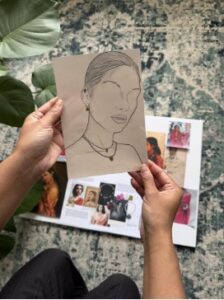
Design sketch for an Ataro Jewellery piece. Combining her background in luxury design at Paul Smith with research into South Asian jewelry traditions, Limma creates pieces that blend Eastern and Western aesthetics to make modern, everyday jewelry that celebrates the cultures of both sides.
Each piece Limma designs carries meaning beyond aesthetics. “Every piece is inspired by different regions of South Asia and the importance jewelry has within those communities.” Looking at the specific shape of an earring or necklace, one can figure out where the design came from, and it can tell a story about the region itself.
Limma’s background in luxury fashion shaped the way she approaches jewelry design. At Paul Smith, she learned that meaningful design begins with research, storytelling and understanding the inspiration behind a collection—an approach she carried into Ataro.
For Limma, the creative process begins long before sketching. She draws inspiration from museums, vintage and antique stores, traditional South Asian jewelry, Islamic art and personal family memories. She says the research process is one of her favorite steps in designing. She believes that each design “…shouldn’t just be a random sketch. There should be a story behind it.”
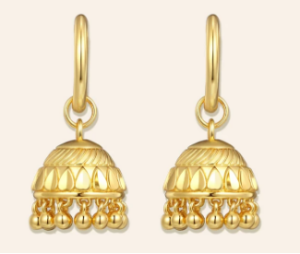
The Micro-Jhumkas, inspired by Limma’s mother and her journey to immigrating to England from Bangladesh.
Many of Ataro’s designs are rooted in personal connections. The Micro-Jhumkas are inspired by a pair of earrings her mother owned and lost after moving to England. Other pieces draw from historical jewelry traditions across South Asia, translated into designs meant for everyday wear.
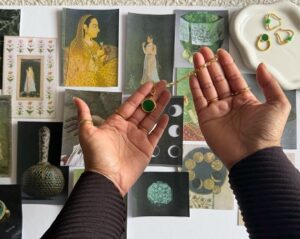
One example is the Moon Swivel Ring from Ataro’s Ramadan collection, inspired by a Mughal-era emerald carving Limma saw at the Victoria and Albert Museum. The piece incorporates lunar symbolism and lotus engravings while creating a more accessible version of the craftsmanship that inspired it.
Sustainability Beyond Materials:
Sustainability at Ataro is not defined by a single material or certification. It is shown throughout the entirety of the production process.
When building Ataro, she wanted to challenge the idea that sustainable jewelry had to come at a premium price. Her goal was to create pieces that were responsibly made, durable, culturally meaningful and accessible to the customers who wanted them.
“I want every part of the process to have as little negative impact as possible.”
The Moon Swivel ring and necklace draw inspiration from Mughal-era art and jewelry. On one side, a lotus is engraved into emerald-toned, hand-treated jade; on the other, a lunar cycle engraving highlights the significance of the moon in Islam and the heritage carried in these motifs.
A major part of that process begins with materials. Ataro uses 18-karat gold-plated eco metals, including brass, which Limma chose because of its durability and ability to be recycled multiple times without losing quality. Each piece undergoes testing to ensure its plating maintains its shine and longevity, allowing customers to keep and wear their jewelry for years without irritating their skin.
The brand’s sustainability approach extends beyond the jewelry itself. Ataro uses FSC-certified packaging made from 70% recycled sources, while its jewelry pouches are designed to be reusable rather than disposable. These decisions reflect Limma’s belief that every part of the customer experience should be considered when reducing waste.
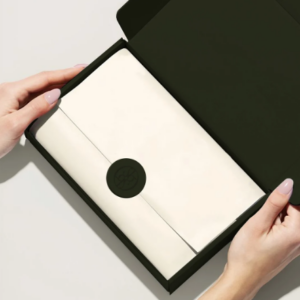
Designed with sustainability in mind, Ataro Jewellery uses FSC-certified packaging made from recycled materials. Every piece comes with a reusable storage pouch, reducing waste and increasing durability.
However, Limma believes sustainability goes beyond materials. She sees overproduction as one of the biggest challenges in the fashion and jewelry industries. “Even if you’re using recycled materials, if you’re making too much, where does all the rest go?” Rather than producing large quantities in each collection, Ataro operates through small-batch production, only replenishing pieces when they sell out. Inspired by other brands that use preorder models, Limma hopes to eventually move to a made-to-order system where products are created on demand to fully cut out extra inventory.
Transparency is another key part of Limma’s sustainability philosophy. Before partnering with manufacturers, she personally visited factories to understand their processes and ensure they aligned with Ataro’s standards around working conditions and responsible production.
“I went to visit the factory before signing with them because I wanted to make sure everything was above board.”
Sustainable practices at Ataro also extend to maintaining fairness with customers. Her approach to pricing is based on Limma’s personal values and religious beliefs: businesses should make profit but never at the expense of a customer. “I don’t believe in overcharging. If it’s something I would be comfortable paying, then I’m comfortable charging that.”
Ultimately, Ataro’s sustainability philosophy is about creating jewelry consciously at every stage. Responsible design means creating pieces that people value and keep.
The Reality of Building a Brand:
Launching her own brand came with its fair share of challenges. Limma’s biggest challenge has been building awareness. “You can have the greatest product in the world, but if nobody knows about it, nobody’s going to buy it.”
She spends a lot of time building trust with her customers and educating them about jewelry materials and the story behind each piece. While trying out different ways to spread awareness, Limma realized that in-person markets and events have been more effective than digital marketing because customers can interact with the pieces and the inspiration behind them.
Another challenge has been navigating customer expectations around the durability of the jewelry, especially with the growing demand for “waterproof” pieces. While many brands are promising jewelry this way, Limma said: “I don’t want to compromise the design just so I can call it waterproof.” Many of Ataro’s pieces are based on intentional craftsmanship and complexity in the design, which makes it hard to simply make them waterproof.

All Ataro Jewellery pieces are made using eco-brass and 18-karat gold plating as part of their sustainable practices, while ensuring durability and making them accessible to those with sensitive skin.
Limma has also learned to accept that being an entrepreneur doesn’t mean she needs to know everything. While her background provided strong creative and branding skills, areas like taxes, administration and business operations were new challenges.
“I realized I don’t have to know everything. I can ask people.”
Limma credits her family, including her father, husband and sister, as her support system for helping her navigate areas outside of her expertise. Rather than viewing help as a weakness, she sees it as a vital part of being a founder.
The demands of building Ataro while balancing her full-time job also forced her to rethink how she approached entrepreneurship. Managing a 9-to-5 career, running a jewelry brand and pursuing creative projects eventually caught up with her when she became seriously ill with pneumonia.
“This is the result of when you don’t take breaks.” The experience changed how Limma viewed personal sustainability. She began creating boundaries: dedicating specific hours to Ataro, putting her phone away after a certain hour, exercising and allowing herself to take breaks. “When you’re doing something super creative, that requires a lot of brain power. Even before you put pencil to paper, you’re thinking, and that takes up a lot.” Limma realized that rest is not separate from productivity, but it allows her creativity to continue.
Despite these challenges, the biggest surprise hasn’t been the difficulty of entrepreneurship, but the fact that she actually did it.
“When you do the thing, when you put your mind on something, you can do it. You just solve each problem as it comes along.”
Redefining Success in Her Community:
Since launching Ataro, Limma’s success has rarely been defined by numbers. Instead, they come from the genuine connections she’s built with her customers.
One of her biggest milestones was seeing an Ataro ring worn on the red carpet, which felt surreal after years of designing behind the scenes. But some of the moments that mean the most to her are much simpler: seeing customers repeatedly wear their jewelry, receiving compliments from strangers or hearing from someone who relates to the story behind a piece. Success to Limma isn’t about creating a one-time purchase; she values creating something that celebrates someone’s identity and makes them feel confident.
“Success is when someone I don’t know buys something because they genuinely connected with it.”
This mindset has helped her navigate the uncertainty that comes with each drop. “After every launch, I wonder, ‘Should I give up?’” Over time, she has learned that building a brand that carries so much meaning takes patience. Rather than measuring herself against companies that have existed for years, she reminds herself that trust and community are built slowly. “It takes five to ten years to build a community. I remind myself not to compare.”
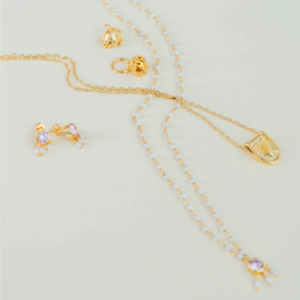
The Rani of Hearts collection, Ataro Jewellery’s debut collection, draws inspiration from a deep, vibrant pink historically reserved for royalty. Highlighting this regal hue, the pieces combine pink cubic zirconia and freshwater pearls with Ataro’s signature 18-karat gold-plated eco-brass.
In the future, Limma hopes to have a community of South Asian women to connect with, such as those who grew up as third-culture kids like herself and struggled to fit in. Through future events, including the idea of an annual Ataro girls’ brunch, she wants customers to connect beyond the jewelry itself. “I want to create a community of South Asian girls who feel celebrated.” Ataro represents the kind of representation Limma wishes she had grown up experiencing.
While fashion has increasingly embraced diverse cultural influences, she believes jewelry still has room to evolve. “Growing up Asian, I don’t think we’ve ever been called cool. We’ve been called nerdy, we’ve been called smart, but it’s a brand that as a community, we haven’t really broken into.” Her long-term vision is not simply for South Asian-inspired jewelry to be accepted but for it to be celebrated. She hopes Ataro can help shift perceptions around cultural identity, showing that heritage can be contemporary, aspirational and deeply personal.
Photos courtesy of Limma Ali and https://www.atarojewellery.com/,
Author: Mahati Desabhatla