Perspectives
A Question That Never Let Go: Bonnie Monteleone’s Lifelong Journey
A Question That Never Let Go: Bonnie Monteleone’s Lifelong Journey
In the mid-1970s, 12-year-old Bonnie Monteleone watched from the kitchen as her mother unwrapped a package of ground beef, peeling back the cellophane and removing the Styrofoam tray beneath it.
“Where does this stuff go?” Her mother wondered aloud. “I heard it sticks around for a thousand years.”
That simple question planted a seed of curiosity in Bonnie, which grew over the next five decades, guiding her through her childhood, college years, and her time as the co-founder and executive director of the Plastic Ocean Project, a 501(c)(3) nonprofit based in Wilmington, North Carolina.
Early years
Growing up in landlocked Elmira, New York, Monteleone’s summers were spent at lakes. That was until she went to the Jersey Shore with her family when she was five. “I didn’t even know what the word ‘ocean’ meant, but once I saw it, I knew that it was what I wanted to be near for the rest of my life.”
And true to her words, Monteleone’s fascination with the ocean never disappeared. It simply lay dormant, simmering below the surface. Through her years at SUNY Cortland, co-owning a pizzeria and raising her children, that early awe she felt at the Jersey Shore lingered in the background, waiting for the moment it would resurface and change her life.
Then, at 46, Monteleone found her way back to the ocean when her daughter attended the University of North Carolina at Wilmington (UNCW).
Back to the Ocean
Moving to the coastal town, Bonnie took an admin position at UNCW while taking graduate courses that led her to her research on marine debris.
Her story of traveling 10,000 nautical miles studying marine debris is one that’s been echoed numerous times and served as the foundation of what would become the Plastic Ocean Project.
Inspired by Mae West, the snapping turtle disfigured by a piece of plastic, giving her an hourglass shape, Monteleone found her totem for her mission.

Image of Mae West

Monteleone pointing to the North Pacific Gyre where she conducted research in the North Pacific Garbage patch
Through her journey traveling four of the five ocean gyres (massive systems of circular-rotating ocean currents), Monteleone witnessed firsthand the overwhelming presence of plastic pollution entangled with marine life and embedded in ecosystems.
“I knew I couldn’t just write the thesis and defend it,” she said. “I knew too much and saw too much.”
Thus, the Plastic Ocean Project was founded.
The Plastic Ocean Project
The Plastic Ocean Project’s mission is to find science-based solutions to the global plastic pollution crisis through 3 pillars: Education Through Outreach, Outreach Through Art, and Solutions Through Collaboration – also known as “Collaborocean.”
Despite the small size of the nonprofit, Monteleone was adamant about the three pillars.
“We don’t have the time to not do all three.”
Monteleone touches upon the Solutions Through Collaboration pillar, proof that to tackle a problem as massive as plastic pollution, partnership and empathy are a necessity.
The Plastic Ocean Project does its best to support small businesses and companies that do their part to actively reduce plastic waste and implement practices to protect the environment. Known as Ocean-Friendly Establishments (OFEs), these businesses scattered across North Carolina and other parts of the world have partnered with the nonprofit to reduce waste. Businesses within the program take it to the next level by adding stars to their certification. Ranging from one to five stars, a business receives its rating based on how many of the 19 OFE criteria it meets.
The nonprofit also does its fair share of promoting larger companies that share the same values on sustainability. Monteleone points out Wes Carter’s Atlantic Packaging Company, a Wilmington-based packaging company that prides itself on environmentally conscious practices and materials.
Nonprofits like the Plastic Ocean Project are part of a larger picture of addressing complex issues. Even though the main perpetuation of plastic pollution is the private industry that pushes the use of virgin plastic, it’s up to individuals and organizations to be aware of where their money is being spent.

Plastic Ocean Project’s Grand Opening
As said by Monteleone, “sustainability just comes down to using less and staying within the boundaries of what sustains life on Earth.” That’s why it’s more important than ever for individuals to be cognizant of where their money goes. By not buying from wasteful companies, you are committing to bettering the health of yourself and the planet.
It’s evident that Monteleone’s entrepreneurial spirit remains intact, even after stepping down as Executive Director of The Plastic Ocean Project. She often returns to the memory of her mother’s question from the 1970s.
“What you say to children really matters, because they’re often the reason people care about our planet.” Monteleone is living proof. From building a nonprofit from the ground up to growing it into a $300,000-a-year organization, her journey shows that when people care, real change is possible.

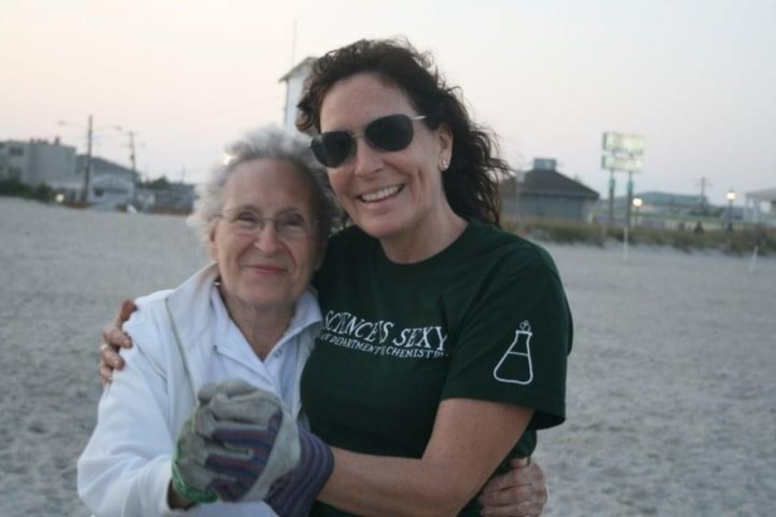
Bonnie Monteleone and her mother Shirley Holden
Written by Rose Kurian